
How to get Swiss Citizenship through Investment
If you’re anything like me when I first started to explore life in Switzerland, then the question of citizenship must have come up fairly soon. Can I really become Swiss one day? It’s about more than just the passport (though that imposing red booklet sure helps). It’s about stability, security, and joining a country known for its order, its freedoms, and its quality of life.
Okay, so I will be the first to admit that Switzerland doesn’t have some special citizenship by-investment panacea that some countries offer. But here is the neat part! There are clever, strategic ways to invest in Switzerland that can ultimately pave your path to citizenship. I spent years researching and talking to people who have done this! Some made it, some got stuck. What I’m sharing here is a real, no-nonsense guide based on what works and what doesn’t.
I’ll explain how it actually functions, what to watch out for, and even some of the cantons that go out of their way to make it easier. My goal? To make things easier on you, because I’m trying to give you the most solid advice I can, the kind I wish I’d had.
 Quick Answer: Can You Get Swiss Citizenship by Investment?
Let me lay the quick, straight answer on you right here: There is no such thing as a straight citizenship-by-investment program in Switzerland like in the case of Malta, the West Indies island of St. Kitts. You can’t buy your way to a Swiss passport.
But don’t despair, because here’s where the true opportunity comes in. You can’t buy citizenship as such, but you can invest your way to residency and, eventually, potentially to Swiss citizenship with the right conditions if you hang on long enough in the country.
There are 2 primary avenues most people look at:
1. Agreement on lump-sum taxation (for wealthy individuals who do not work in Switzerland)
2. Business investment/entrepreneurship – (if you are playing an active role in the Swiss economy).
Both demand commitment and long-term thinking. This is a marathon, not a sprint. If you maintain legal residency for at least roughly a decade (possibly less, depending on your circumstances), become mixed up in the community, and can demonstrate you have language and basic civic knowledge, naturalization is an option for you.
I have personally met people who took those paths. One retired investor who had settled in Ticino under the lump-sum tax system and who became a citizen after years of community involvement. Another launched a tech start-up in Zug, creating local jobs, and worked his way to permanent residence.
So, yes, you can buy your way into Swiss citizenship. It simply requires an appropriate approach, patience, and a sincere desire to be an active part of life in Switzerland.
Option 1: Lump-Sum Taxation Route
This is one of the most talked-about routes for wealthy individuals looking to live in Switzerland, and it’s honestly the closest thing to investment-based residency the country offers.
I first learned about the lump-sum taxation agreement through a friend from the UK who was semi-retired and looking for a peaceful, high-quality lifestyle. He didn’t want to work in Switzerland but was happy to contribute financially, and this option fit perfectly.
What is the Lump-Sum Taxation Route?
Under this system, you don’t pay taxes on your global income, like you would in most countries. Instead, you pay a pre-agreed, fixed amount of tax each year to the canton (region) where you live. This is calculated based on your living expenses, not income or wealth.
- Minimum starts around CHF 150,000/year, but can be significantly higher depending on the canton.
- You cannot work or conduct business in Switzerland under this scheme.
- It's only available to non-EU/EFTA nationals who are not already employed or active in Switzerland.
Cantons That Offer It
Not all cantons participate. Popular ones include:
- Vaud
- Valais
- Fribourg
- Ticino
- Geneva (for very high-net-worth individuals)
Each canton negotiates independently, so the final tax amount and conditions can vary a lot.
Pros:
- Simple, predictable taxation
- Discreet and private process
- Ideal for retirees or financially independent individuals
- High standard of living in a peaceful, safe country
Cons:
- Expensive, definitely not for the average investor
- No work is allowed in Switzerland.
- Citizenship still takes 10+ years, with full integration required (language, community, etc.)
My Personal Advice
If you’re already financially comfortable and looking for a quiet, secure base in Europe, this could be a great option. But it’s not passive. Swiss authorities will expect you to genuinely integrate, not just park your money here.
I’ve seen people succeed when they join local clubs, learn the language (at least basic German, French, or Italian), and participate in community life. Citizenship is earned here, not bought.
Option 2: Business Investment Route
If you’re the kind of person who enjoys building, creating and engaging in the work you’re doing, then this option may be perfect for you. With the business investment route, instead of going the route of lump-sum tax, you can actually be an active part owner in a Swiss company and consequently, establish a long-term foundation toward residency and (eventually) citizenship.
I’ve spoken with a number of entrepreneurs who’ve taken this route: some opened tech startups in Zurich, others started small manufacturing firms in the Bernese countryside. What was common to all of them? DEDICATION, patience and working close to home.
How the Business Investment Route Operates
If foreign entrepreneurs bring value, they are welcome in Switzerland. Here's the typical process:
1. Set up or invest in a Swiss Company
You’ll need to:
- Incorporate a Swiss legal entity (generally either a GmbH or AG)
- Minimum investment (CHF 20,000+ for GmbH, CHF 100,000+ for AG)
- Demonstrate that the business will produce a positive economic impact locally (jobs, taxes, innovation).
2. How to apply for a Residence Permit (B Permit)
If your business is accepted, you get a resident permit to:
- Live and work in Switzerland
- Get involved in the day-to-day of your business.
- Bring eligible family members.
3. Run the Business Successfully
This is not a paper company trajectory. Swiss authorities will check:
- Is your business actually open?
- Are you creating local jobs?
- Contribute to the economy or not?
4. Apply for Citizenship: After 10–12 Years
If you’ve been living continuously, with integration (language, culture), and a clean legal record, you can apply for naturalization.
Pro Tips (from Real Experiences)
Pick a canton that is open to business immigration (ie, Zug, Schwyz, Vaud).
Be hands-on - The Swiss are suspicious about entrepreneurs who just sit as shareholders.
Learn the local language - it’s not optional if you want citizenship.
Employ a local business consultant or immigration attorney. The bureaucracy is slippery, and missteps are expensive.
This is perfect for people who want to make a life, not just a status purchase.
 Key Requirements & What to Expect
One thing you’ll quickly learn about Switzerland it’s not just about how much money you bring in. It’s about how well you fit in. Swiss citizenship is rooted in community, culture, and contribution. Whether you take the lump-sum taxation route or start a business, the citizenship requirements stay the same once you’re a resident.
Here’s what you need to know:
Residency Duration
- Standard requirement: 10 years of continuous legal residency
- Some cases, like marrying a Swiss citizen or being raised in Switzerland, allow for easier naturalization. But for most investors, the process takes 10 years.
- At least 3 out of the last 5 years must be spent physically living in Switzerland right before you apply.
Language Requirements
- You’ll need to prove language proficiency:
- A2 level in speaking
- A1 level in writing
- The specific language depends on your canton (German, French, Italian, or Romansh)
Integration & Community Involvement
- Show that you understand and respect Swiss laws, customs, and values
- Engage locally, join clubs, support local causes, and build relationships
- Authorities may interview you and even ask neighbors for feedback (yes, really!)
What to Expect (My Advice)
This is not a checklist you tick once! It’s a process of becoming part of the community. The Swiss value trust, reliability, and modesty. If you bring a genuine desire to live and contribute, you'll be welcomed.
My Personal Insight & Real-Life Examples
I have lived in Switzerland long enough to know that while the rules are black and white, the path to citizenship is all shades of grey. It’s not a matter of checking off boxes it’s about where you fit in, and honestly? That can be both exciting and humbling.
I recall meeting a couple from South Africa who made their way to Valais via the lump-sum tax. They weren’t flashy or gaming the system they were just seeking a quiet life, close to the mountains. What stood out? They got involved in a local hiking club and took night classes in French, and eventually they were invited out in the community. When they were due to apply for citizenship, in fact, their neighbours vouched for them. That’s Switzerland for you.
Another one, a friend of mine from India, opened a boutique consulting shop in Zug. It was challenging at firs,t paperwork, staffing with locals,and building trust. But as his business expanded, and he began mentoring local startups, he came to be a recognizable figure in the community. Eight years later he was given Swiss citizenship and not just for being an investor, but for enriching his community.
Here is what I have learned from my own experience: Switzerland responds to those who respect its values moderation, consistency, and participation. You don’t need to be a different person, but you do need to show up and participate. Whether it’s investing in a company or deeply knowing people in your village that’s what really matters.
So if you’re thinking long term, bring the attitude of joining, not merely settling.
Pros & Cons + Best Cantons
You’ve likely already noticed by now that all this about becoming a Swiss citizen by investment is no shortcut! It’s a formal, long-term investment. But with the right person, it can definitely be worth it. Here’s a brief comparison to get the gears turning:
Pros
- Even more ways of life, along with world-class health and education centres
- Sovereign and highly respected passport in the world
- Investment-friendly economy, particularly in cantons such as Zug and Schwyz
- Chance to construct a permanent abode in one of the world's most liveable nations
Cons
- Nothing as straightforward as a “citizenship-for-cash” program, time and integration are non-negotiable.
- High standard of living, especially in cities like Zurich or Geneva
- Bureaucracy is slow and different in each canton.
- It takes over 10 years to get citizenship, even with a heavy investment
Top Cantons to Consider
Here are some cantons renowned for their business-friendliness or at least more welcoming under the lump-sum tax system:
- Zug – Low tax, excellent start-up conditions, good for tech or finance
- Schwyz – business-friendly, under-regulated
- Vaud – Retrieved among pensioners for the capital option
- Ticino – Italian language and lifestyle, fair tax treaties.
- Valais – Quiet, beautiful, and open to international buyers
Each canton has its own rules – do some research or ask around locally before making your decision.
Step-by-Step Guide
If you’re really serious about getting Swiss citizenship by investment, here’s a clear, no-fluff road map to guide you on exactly what to do and in what order.
1: Decide Your Route
Choose between:
- Special Tax Treatment by Lump Sum (for the independent worker)
- Business Investing (for Entrepreneurs & Active Investors)
2: Choose the Right Canton
Research and select a canton that aligns with your goals (taxes, language, business opportunity, lifestyle)
3: Apply for Residency
- For lump-sum: agreement on the tax amount with the canton
- For work: start a business and apply for a residency permit
4: Integrate & Contribute
- Speak A2, Write A1 of the local language.
- Get involved in the community, this matters more than you think
5: Stay Committed Long-Term
- For at least 10 years in Switzerland
- Obey the laws, pay taxes, and have a clean record.
- Make relationships, it's a massive thing in your application.
6: Apply for Citizenship
- Apply through your local commune, canton, and federal levels as soon as you are eligible.
- Get ready for the interviews and assessments.
It’s not just a passport you are buying you are building a life here. Succeed, and Switzerland will embrace you.
Let’s Talk – Your Swiss Journey Starts Here
If you’ve read this far, I also hope you feel more confident and knowledgeable about this route to Swiss citizenship via investment. I designed Swiss Sustain to be more than a website! It’s your own personal guide to living, investing, and succeeding in Switzerland.
Still have questions about which way to go? Not sure how to deal with cantonal regulations? Or do you just have something on your mind you want to share? Leave a comment below or send an email. I read this stuff and can help.
Sign up for more real-life stories like this inside your inbox. Subscribe we will use your email address only for sending you newsletters. Please refer to our Privacy Notice for details of your data protection rights.
Share this article with any friends who are contemplating life in Switzerland.
Fill out the form, @Swiss_Sustain will take care of you personally, answer any questions you have, or point you to the best resource!
At times, this journey can feel overwhelming! You may feel lost at times; however, you’re not alone. Let’s make your Swiss dream a reality step by step, the right way.


What is the Fastest Way to Become a Swiss Citizen
So, you’re looking to become Swiss? First of all, welcome! You’re not the only one, whether you’re dreaming of lakeside life in Lucerne or mountain mornings in Zermatt. I’ve spent years living in Switzerland, and I totally understand the appeal. Everything from the clean streets, safe cities, on-time trains, and unrivalled nature feels like I’m living in a real-life fairytale.
But truth be told, obtaining Swiss citizenship is no walk in the park. The process is notorious for being rigorous, detailed, and occasionally… well, a little slow. But there are ways to speed up and smooth the process if you know how.
When I first came to Switzerland, everything was just… perfect. Trains were on time, the air was pure, and people played by the rules and nature. Absolutely surreal. Then the honeymoon phase wore, and I found myself asking bigger questions: Can I really make this my forever home? Can I belong here? How do I become a citizen? And what, above all, is the speediest and most practical way to get it done?
Which is where this guide comes in. No fluff, no nonsense just a clear, personal guide to Swiss citizenship.
I have been working my way through the system in recent years, and I have guided friends through the same. I’ve faced a lot of trial and error. I asked many questions at my local Gemeinde office, but I was too scared to hear the answers. There are also a few things I wish someone had told me from Day One. That’s why I started Swiss Sustain to be part of helping make your way clearer, to offer the kind of guidance I wish I’d had.
 Why Become a Swiss Citizen? (And Why I Chose To)
OK, being honest with you: you don’t need Swiss citizenship to have a great life here.
Switzerland is one of the best places to live in the whole world, for locals as well as for expats. With a C permit, you can live and work, go where you want, when you want, and appreciate 90% of the rights that a citizen enjoys. At some point, though, that tiny question began lurking in the back of my mind: Do I really have a place here, or am I just visiting?
That was when I started to understand the true significance of acquiring Swiss citizenship and why it’s about so much more than just a passport.
You Get a Say in the Country’s Future
One of the more unusual things about Switzerland is the extent to which direct democracy is a part of daily life. Citizens visit the ballot booth for a national referendum several times every year. You won't just count politicians and laws. You'll also vote on big changes, like the tax system or building a tunnel under the Alps.
As a longtime resident there, it was strange to see these decisions being made without me. I was a citizen here, paying taxes and making a contribution to society, but I had no voice. That changed when I became a citizen. And let me tell you, voting here in Switzerland feels powerful. You have a place in something that is real.
More Freedom, Fewer Headaches
I remember that, when I wasn’t yet a citizen, every few years, there would be this little thing: What if my permit doesn’t get renewed? What if I change jobs? What if rules change?
Even with a C permit, you remain an outsider in the system. You have to qualify, report your life changes, and prove your stability over and over.
Now? That pressure is gone. I can move anywhere in the country whenever I want. I don’t need permission. If I dislike how one state treats my rights, I can simply move to another. I won’t worry about being sent away on a boat or plane. Essentially, he’s giving me a big, symbolic boat, but he wants to keep those boats he gave to others. That brand of peace of mind is difficult to describe if you haven’t experienced it.
When We Think About the Future - For You and Your Family
If you’re a parent of kids in Switzerland, this is huge. It is about opportunity citizenship opens doors for them, from education to scholarships to the chance to serve in the nation. It provides them with full rights in the only country they might ever know as home.
Even if you are unattached right now, look ahead in time. To be Swiss is to be grounded here, and that means security, stability, and a future.
A Sense of True Belonging
I was really struck by this one more than I thought I would be. I used to cringe when people would ask me where I was from. Well, I’m Switzerland but I’m originally from…
But something changed after I became Swiss. It wasn’t just that I was living in the country I was part of the country.
I voted. On Swiss National Day, I was celebrating not as a spectator, but as one of them.
It’s hard to explain, but belonging is more potent than it may seem.
Is It Worth It?
It’s not easy. It is a matter of time, patience, and genuine integration. But if you love living here, if you see your future here, and if you want to stop sitting on the sidelines, then yes, absolutely, it’s worth it.
You are not just getting a red passport. You’re building a future. You’re saying, this is home.
 The 3 Main Paths to Swiss Citizenship (Quick Overview)
Before working in Switzerland, you need to know one important thing. It doesn’t matter what visa or contract you require. This knowledge is essential before you begin paperwork, interviews, or language tests.
There’s not just one way to become a Swiss citizen.
You might even be eligible for a quicker or streamlined path, based on your situation. When I started this quest, I was surprised by how many people didn’t know there were three main paths. Choosing the right one can save you years of waiting.
Here’s a quick breakdown:
1. Standard Naturalization (The Common Way)
This is the simplest path for foreigners who have been in Switzerland for years. It requires:
- A minimum of at least 10 years of living in Switzerland (under certain conditions),
- Settling into Swiss life (language, community, not in legal trouble),
- And familiarity with Swiss culture, politics, and daily life.
This is the path I myself went down, and not once you pin it right, breaking it down, I promise, it's not that frightening.
2. Facilitated Naturalization (The Faster Option)
You may qualify for a faster, simpler process if you meet any of these criteria:
- You are married to a Swiss citizen.
- You were born to a Swiss parent outside of Switzerland.
- You completed your primary and secondary education in Switzerland.
Other niche categories, like second-generation foreigners, also apply.
Generally, it’s faster, it’s less expensive, and it gets you past some of the more stringent requirements.”
But: Not everyone qualifies. We will dig into the specifics in a second.
3. Citizenship by Birth or Descent
You could already have a right to citizenship, or at the very least to have it renewed, even if you were born elsewhere and one of your parents is Swiss. This isn’t exactly something you “apply” for, but it’s worth checking to see if there’s Swiss blood in your family tree.
So Which One’s Right for You?
Each path has its own timeline, its own prerequisites, and its own idiosyncrasies. I’ll take you into all the other paths in the following sections:
- Who qualifies
- How long does it take
- What documents do you need?
- And some irl advice based on my own experience
This summary should give you some guidance about which goal to start with. Next, let’s talk about Facilitated Naturalization, usually a fast route to citizenship in Switzerland.
Facilitated Naturalization (Fastest Option)
If you’ve ever Googled the easiest way to become a Swiss citizen, this is probably what came up.
Facilitated naturalization is the quickest and easiest way to get Swiss citizenship. But there’s a catch: you must meet certain conditions. It may not suit everyone, but if you qualify, you could save years of waiting. Plus, you might avoid thousands of francs in application fees and red tape.
Who Qualifies for Facilitated Naturalization?
Let’s start with eligibility. You may qualify for this fast-track process if you fall into one of these categories:
- Spouse of a Swiss citizen
You can apply for facilitated naturalization if:
- You’ve been married to a Swiss citizen for at least 3 years, and
- You’ve lived in Switzerland for a total of 5 years, including the last 12 months continuously before applying.
Personal Tip: I know a couple who applied just months after reaching the 5-year mark and they got approved in under a year. But the key? They were well-integrated and spoke the language confidently. This process moves fast if you’re prepared.
- Child of a Swiss parent
Even if you were born abroad, you may be eligible if one of your parents is Swiss and you were registered at birth (or re-registered later).
- Second-generation foreigners
If you were born in Switzerland to non-Swiss parents and spent most of your life here, you may qualify under the facilitated route.
- Stateless persons or individuals with close ties to Switzerland.
Key Requirements (Even if It’s Facilitated)
While this path is “easier,” it still requires:
- Proof of integration: You must respect Swiss laws, values, and customs.
- Language proficiency: Minimum A2 written and B1 spoken in the national language used in your canton (German, French, Italian).
- No criminal record: A Clean legal and financial history is essential.
- Stable residency: Especially for spousal applications, showing stable cohabitation is crucial.
Important: The federal government takes care of facilitated naturalization. This means your local authority is often not involved. As a result, the process can go much faster.
How Long Does It Take?
From what I’ve seen and from stories people have shared with me it typically takes 6 to 12 months from application to approval. That’s lightning-fast by Swiss standards.
But timing depends on:
- How complete and accurate are your documents?
- Background checks
- Language proficiency
- Backlog in the federal office
So if you want it to go smoothly, don’t rush the preparation.
Costs of Facilitated Naturalization
It’s also cheaper than regular naturalization. On average:
- CHF 500–900 total, depending on your case
- Sometimes even less for children
Compared to regular naturalization (which can cost over CHF 2,000–3,000 when you factor in communal and cantonal fees), it’s a significant saving.
Real-World Pros and Cons
Pros:
- Faster and more efficient process (no commune or canton approval needed)
- Lower cost
- Less red tape you skip the interviews with local councils
- Ideal for those already connected to Swiss citizens or the country itself
Cons:
- Not available to most long-term residents (only special categories)
- Still requires full integration (language, legal, cultural)
- Can be denied if you don’t show ties to Swiss life
- Spouses must genuinely live together separation or unclear housing arrangements can raise flags.
My Final Advice (If You Qualify)
If you’re married to a Swiss citizen or fall into one of the eligible categories, this is the route I’d recommend 100%. But here’s what I always tell people:
Facilitated doesn’t mean automatic. You still need to show you’re part of Swiss society, not just on paper, but in everyday life.”
So go all in. Learn the language, join your local club or community, understand the culture, and be visible. I’ve seen people speed through this process with a good application, and I’ve seen others wait because they thought being married was “enough.
Up Next: Regular Naturalization - The Standard Path
If you don’t qualify for facilitated naturalization, don’t worry. Regular naturalization is still possible. It just takes a bit more time and effort.
In the next section, I’ll break down the process I personally went through, including all the tips I wish someone had told me before I started.
Regular Naturalization (Most Common Route)
When I first looked into Swiss citizenship, I wasn’t married to a Swiss national, I didn’t have any Swiss parents, and no shortcuts applied to me. That meant I had one option: regular naturalization the long road.
And while it’s definitely more involved than facilitated naturalization, I want you to hear this from someone who’s been through it:
Yes, it takes time. But no, it’s not impossible. If you're committed to building a life here, it's absolutely worth it.
Let me walk you through exactly how it works from eligibility to the paperwork, to the often-dreaded interviews with tips I wish I had known sooner.
Who Can Apply for Regular Naturalization?
Here’s the basic requirement to even start the process:
- You must have lived in Switzerland for at least 10 years
- At least 3 of those years must be within the last 5 years.
- You must hold either a B or a C residence permit.
- You must be “integrated” into Swiss life language, community, and culture.
Good news: Years spent in Switzerland between the ages of 8–18 count double! So if you moved here as a teenager, you may be eligible sooner than you think.
What Does “Integrated” Really Mean?
This part can feel vague, but here’s how Swiss authorities define integration—and how I experienced it in real life:
You need to:
- Speak the local language at a minimum level of B1 spoken, A2 written
- Show knowledge of Swiss geography, history, politics, and customs.
- Participate in local life this could mean joining a sports club, volunteering, or even just attending town events.
- Respect Swiss laws and values.s
I joined a local hiking club and helped out at my daughter’s school events. Not only did it help with the process, but it also made me feel like I belonged here.
Step-by-Step: How the Process Works
Here’s the real-life breakdown of the naturalization process, from start to finish:
Step 1: Gather Documentation
Start by collecting:
- Proof of residence (permit history)
- Language certificates (recognized by your canton)
- Tax records
- Proof of employment or financial independence
- CV and motivation letter
Personal Tip: Write your motivation letter in the local language if possible. It shows respect and effort.
Step 2: Apply at Your Commune
You submit your application to your local commune (municipality), not the federal government. This is where things start to feel very Swiss.
You may be asked to:
- Attend an interview with your local authorities
- Meet with cantonal representatives.
- Provide references (neighbours or community members)
Some communes might send a questionnaire. They may ask about recycling rules or your knowledge of Swiss voting systems. Yes, really!
My Experience: I was nervous about the interview, but it was surprisingly casual. They asked why I loved Switzerland, how I participated locally, and a few basic questions about Swiss politics and geography. They weren’t testing me they just wanted to know if I genuinely belonged here.
Step 3: Cantonal and Federal Approval
Once your commune is happy, the canton reviews your application. After that, it goes to the federal level for final approval.
Each layer can take a few months, and the whole process from application to approval usually takes 12 to 24 months.
How Long Does It All Take?
Here’s a realistic timeline:
- Preparation phase (documents, language tests): 3–6 months
- Commune review and interview: 3–6 months
- Cantonal review: 4–6 months
- Federal approval: 4–8 months
So from start to finish, expect 1.5 to 2 years, depending on your canton and how prepared you are.
How Much Does It Cost?
Regular naturalization costs vary depending on your commune and canton, but here’s a general estimate:
- Commune fees: CHF 500–1,500
- Canton fees: CHF 500–1,000
- Federal fee: CHF 100
In total, expect to spend CHF 1,000 - 3,000. It’s an investment, but remember, citizenship lasts for life.
Pros and Cons of Regular Naturalization
Pros:
- Full rights: vote, travel, no permit renewals
- Feels like “coming home”
- Your children can benefit from your citizenship.
- More freedom to move within Switzerland without reapplying for permits
Cons:
- Long waiting period (10 years minimum)
- Requires effort in integration and language
- Each commune can have slightly different expectations.s
- The process can feel intimidating at first
Final Thoughts From My Own Journey
There were moments when I doubted whether it was worth it. The paperwork, the waiting, and the language learning, all felt overwhelming. But when I finally held that little red passport in my hand, I knew I was a resident now.
I was Swiss. I belonged.
So if you’re thinking about it, go for it. Start preparing now. Join that local club, take that language course, and get to know your neighbours. It’s not just about a passport, it’s about building a life and being accepted in a country that values stability, honesty, and contribution.
Language & Integration (The Biggest Barrier for Most People)
To be real, this is where most people are choking.
When I first embarked on my path to citizenship, I wasn’t that concerned by paperwork, or even by interviews. But the language? That seemed like a mountain I wasn’t sure I would be able to climb.
If you’re not already fluent, it’s okay to feel overwhelmed. But here’s what I want you to know from my own experience:
You don’t need to talk like a professor, just a neighbour.
Let’s unpack it, bluntly, pragmatically.
What are the Language Requirements?
To apply for Swiss citizenship, you need to show you can speak one of the national languages. These are German, French, Italian, or Romansh. The language you choose depends on where you live.
The list includes the following minimums:
- B1 spoken
- A2 written
In plain terms:
You can have a chat about your job. Talk about both the every day and the special things you do. Also, share something about Switzerland.
You should be able to pen a brief letter, an e-mail, or a couple of paragraphss without making too many errors.
Pro Tip: Most cantons also accept official certificates, such as the telc, Goethe-Zertifikat, DELF, or FIDE. Ensure you have one that is valid in your canton!
How to Learn a Language Without Going Crazy
This is what has worked for me and for many other people I’ve talked to:
- Use It Every Day
I had to impose a rule on myself: never, ever speak in English at the grocery store. This may all sound easy, but those little gestures mount up. Even ordering a coffee in German/French is something.
- Language Meetups & Tandems
I did one of the most awesome things ever: I found a language tandem, I helped a person learn English, and they helped me with German. It’s low-pressure and very real-life.”
- Listen & Read Like a Local
Change the language on your phone, Netflix, or Spotify to that of your host country. Watch Swiss news, listen to local radio, and read signage out loud. It’s training your brain to think and feel in the language.
- Take a Recognized Course
If you have problems with motivation, be part of a course focused on preparing you for one of the FIDE or telc exams. These programs also often have a citizenship component.
What Does Integration Really Mean?
The Swiss want to know that you’re not merely living in Switzerland, but living with Switzerland.
That means:
- Understanding the Swiss principles and mentality: democracy, neutrality, community
- Getting involved locally: by joining a club, attending events, or just saying hello to your neighbours
- How the system works: taxes, recycling, voting, etc.
Their eyes lit up when I said I’d helped to organize a clean-up day in my village during my interview. It wasn’t really about the trash, it was about being in the community.
Don’t Stress - Prepare Smart
You don’t have to be perfect. The goal is not to think and talk like a native speaker or a political wonk, it is to live as a participant in the Swiss way of life.
My advice? Start early. Be consistent. Speak when you feel weird about it. Show up in your community. But the more you do, the more it becomes second nature, and trust me, it’s worthit when that fat envelope arrives saying “Herzlichen Glückwunsch!
How to Speed Up the Process (Realistic Tips)
If there’s one question I get all the time, it’s this:
Is there a way to speed up Swiss naturalization?
The short answer? Yes, but only if you do the right things. The Swiss system isn’t built for shortcuts, but it does reward preparation, consistency, and integration. I learned this the hard way.
So here’s what works and what doesn’t.
What Actually Speeds Things Up
- Start Collecting Documents Early
Don’t wait until the day you qualify to begin. Gather:
- Permit history
- Tax records (usually last 3–5 years)
- Language certificates
- Proof of employment or financial independence
I had all my documents ready before I was even eligible and it saved me months. The people at my commune were impressed, and everything moved faster.
- Get the Right Language Certificate
Some cantons are very picky. Choose a federally recognized certificate like:
- FIDE
- telc
- Goethe-Zertifikat (German)
- DELF/DALF (French)
Tip: Take the language test a year before applying, so you have time to retake it if needed.
- Be Visible in Your Community
Swiss naturalization is not just about living here, it’s about belonging here.
Things that help:
- Join a local club or volunteer
- Greet your neighbours (yes, it matters!)
- Attend a village/town event.
I joined a local chess club and helped at the school bake sale. During my interview, the officials knew me by name. That personal connection? Huge advantage.
- Apply in a Fast Commune
Not all communes process applications at the same pace. Some are known for faster, more efficient processes, while others are notoriously slow.
If you're flexible with where you live, ask locals or expats about their experiences. Just a different postcode can mean 6 months faster.
- Keep Your Life Stable During the Process
If you move cantons, change jobs, or switch permit types during the process, it can trigger delays or even restarts. Try to keep things stable until your citizenship is confirmed.
What Doesn’t Speed Things Up (But People Think It Does)
Paying More Money
This isn’t a private service! More fees won’t get you faster approval. It’s not like expediting a passport. Stick to the official routes.
Asking for Special Favors
Swiss bureaucracy is fair but strict. Trying to “push” your case or pull strings will likely backfire. Respect the process, and you’ll be treated fairly.
Rushing Through Integration
Integration is observed over time. Signing up for a club a month before your interview won’t impress anyone. Be consistent, and be real.
Final Advice
If you’re serious about speeding things up, focus on what you can control:
- Be prepared before you're eligible
- Be present in your community.
- Be proactive, not reactive.e
That’s how I did it, and while I couldn’t skip the 10-year wait, I cut the post-application process down to 14 months (which, by Swiss standards, is lightning fast).
 Can You Buy Citizenship in Switzerland? (Let’s Bust the Myth)
Let me just say this straight out:
No, you can’t buy Swiss citizenship. >Not for CHF 1 million. Not for CHF 10 million. Not even with a chalet in Zermatt.
Switzerland doesn't offer "golden passports" or investor citizenship programs. And believe me, I’ve looked. When I first moved here and heard rumors about “investment routes,” I thought, maybe there’s a faster way. But it’s simply not how the Swiss system works.
But What About Business or Investment Visas?
There are ways to get residency through investments. For example, the Swiss lump-sum tax is for ultra-high-net-worth individuals. You can also apply for a business permit if you create jobs in the country. But even then:
- You still need to live in Switzerland for 10+ years
- You still need to go through the naturalization process.
- You still need to meet language and integration requirements.
I’ve met expats who’ve run successful companies here for many years. Still, they had to take the language test and go through the same citizenship interviews as everyone else. Money doesn't skip the queue.
Why Doesn’t Switzerland Sell Citizenship?
Because Swiss citizenship is a matter of identity, not money. It’s based on shared values, participation, and integration, not just economic contribution.
That’s one reason why the process is long and thorough. But it’s also why Swiss citizenship is respected worldwide. When you earn it, you truly belong.
Bottom Line
So if you're hoping to fast-track citizenship by writing a big cheque, I'm sorry to disappoint. But if you're here to build a life, learn the culture, and be part of the community, you’re already on the right path.
Personal Story / Lessons Learned
When I relocated to Switzerland, I could never have envisaged applying for citizenship.
At the outset, everything seemed alien. We didn’t understand why stores closed early. Our neighbours seemed quiet and reserved. Recycling rules were strict, too. I once got a friendly but stern note for not sorting my PET bottles. I was a foreigner in a country that operated on rules, organization, and a profound community spirit.
But something shifted over the years. Or maybe I changed.
I started to see the beauty in how things worked. The trains that ran on time. The integrity of those who decide to leave a bicycle unlocked in small towns. The examples given tend to be pride in local folkways, such as cow parades in the Alps or the lighting of lanterns on Swiss National Day. I began to fall in love with the quiet self-assurance of Switzerland.
Yet the prospect of becoming a Swiss citizen seemed … distant. Complicated. Almost untouchable.
The Start of My Journey
After about 7 years of living here, I started seriously looking into naturalization. Since I wasn’t married to a Swiss, wasn’t born from Swiss parents, and definitely wasn’t wealthy, there were no shortcuts.
I can remember sweating buckets as I went into the big office, not having a clue what was going to happen. The idea that I faced only cold bureaucracy wasn't entirely true. I also met helpful staff. They wanted to support the process, as long as I was serious.
That was the main lesson:
The system is not rigged against you, it simply wants you to work.
The Toughest Parts
There's no question that the language was the hardest for me. Living in a German-speaking canton, I could order food and ask for directions. However, having a B1-level conversation felt like a big jump.
I decided to enrol in a course near me and listened to Swiss German YouTubers. I learned with my daughter, who already knew from school. Bit by bit, it got easier.
There were times I felt like giving up when the combination of work, family, and language study became too heavy. But then I would go hiking and look at the mountains and remind myself why. My home was Switzerland, of course, but not only. It was my home.
What I Wish I Knew Sooner
If I could travel back in time and tell myself things I wish I’d known when I started, here’s what I’d say, and it’s a list I now share with young journalists:
- Start preparing early. Start collecting documents, learning the language, and integrating well before your application.
- Be visible in your community. Say hello, get active in neighbourhood groups, and become a part of the community. It’s more important than you may realize.
- Do not pursue perfection, but display consistency. Swiss officials want to see effort, respect, and a real desire to belong.
Final Reflection
When I finally got the letter that said I was approved, I cried. Not that I had a new passport, but that my pledge had been acknowledged. I was no longer just a guest. I was Swiss.
And that’s what I want for you as well.
If you are on this path, consider this:
You don’t have to be perfect or rich or born into the system.
All you need to do is show up, be open, and be honest. Switzerland sees that. It values it. And eventually, it will welcome you back with open arms.
Common Pitfalls to Avoid (Save Yourself Time & Headaches)
If I had a franc for every time someone told me,
I didn’t realize that would be a problem… I could probably cover my next Swiss health insurance bill.
There are a handful of common mistakes people make on their path to Swiss citizenship and the truth is, most of them are totally avoidable. I learned a few of these lessons the hard way, so I want to help you steer clear of the same traps.
1. Waiting Too Long to Start the Process
Many people think I’ll deal with it when I hit the 10-year mark. But honestly, you should start preparing by year 7 or 8.
- Gather your documents ahead of time.
- Get your language certificate in hand.
- Start engaging more visibly in your community.
I started collecting my paperwork 2 years before I applied. When it was time to submit, I was already ahead and that saved months.
2. Assuming All Cantons Have the Same Rules
Switzerland is a federal country, which means your commune and canton have a big say in how your application is handled.
- Some communes want proof of integration at a hyper-local level
- Others might have more lenient or stricter requirements.
- Interview formats and timelines can vary a lot.
Always check with your local Gemeinde (commune office) for specifics. National rules are the base, but locals have the final word.
3. Underestimating the Language Requirement
Here’s the truth: language can make or break your application. I’ve seen people with great jobs and solid integration get rejected simply because they couldn’t meet the language standard.
- Start early
- Practice often
- Take a recognized exam (FIDE, telc, etc.)
The interview isn’t just a formality, it’s your chance to show your comfort with the language in real life.
4. Thinking “Being Quiet” is Enough
Swiss people are polite and private, but they value involvement. Sitting on the sidelines for a decade, even if you’ve followed every rule, might not be enough.
You don’t need to run for local office, but:
- Say hello to neighbours
- Join a local club
- Volunteer or participate in communal events
During my interview, they asked, How do you contribute to your community? I was glad I had something real to say.
Moving Cantons Right Before Applying
Big mistake! If you move to a new canton or commune just before applying, you might have to restart the local integration period (often 2–5 years).
Unless absolutely necessary, stay put during your final application phase.
Bonus Tip: Don’t Assume Anything
Ask questions. Visit your local office. Join expat forums. Talk to others who’ve been through it.
The most confident applicants I’ve seen weren’t the ones who had everything figured out, they were the ones who asked for help when they needed it.
In Summary:
Steering clear of these mistakes can save you time and help avoid a rejected application. Be proactive, stay informed, and lean into the process. It's not just a checklist, it’s a journey that, if done right, will feel incredibly rewarding when that final yes comes in.
Checklist to Get Started Today
Prepared to start your process of obtaining Swiss citizenship? Let us ensure that the path ahead is smooth for you.
No matter if you’re starting fresh or are halfway done, this simple guide will help you move forward step by step.
Your Swiss Citizenship Starter Checklist:
- Check Your Eligibility
- ☐ Have you lived in Switzerland for at least 10 years?
- ☐ Do you have a permanent residence permit (Permit C)?
If you’re applying for facilitated naturalization (through marriage or descent), check the special rules.
- Get Your Language Certificate
- ☐ Reach B1 level (spoken) and A2 (written) in the local language
- ☐ Choose a recognized test (FIDE, telc, Goethe, etc.)
Tip: Take the test early, so you have time to improve if needed.
- Gather Essential Documents
- ☐ Proof of residence history (Wohnsitzbescheinigung)
- ☐ Tax records (usually 3–5 years)
- ☐ Employment or financial stability proof
- ☐ Language certificate
- ☐ Criminal record extract
- Show Community Integration
- ☐ Join a club, local group, or volunteer
- ☐ Participate in communal events or meetings
- ☐ Be known in your neighbourhood (yes, even saying hi helps!)
- Check with Your Commune
- ☐ Visit your local Gemeinde office
- ☐ Ask about specific requirements for your canton/commune
- ☐ Request a naturalization guide or checklist if available
- Avoid Last-Minute Changes
- ☐ Stay in the same canton until your application is processed
- ☐ Keep your job/residence status stable
Final Thoughts
Becoming a Swiss citizen is not about ticking boxes, it’s about establishing a life here, a step at a time. And yes, it takes patience. But: With the proper encouragement, prep and mental attitude, you absolutely can.
I’ve walked this same path from confusion and red tape stress to the moment I held my Swiss citizenship certificate in my hand. And if I could turn back the clock and do it all over again, I’d do just one thing differently: I’d have moved faster, and I’d have found honest advice earlier.
This is why I started Swiss Sustain - to provide a space where you could get real answers, some personal experience, and practical advice. If you found this guide useful, check out the dozens of up-and-coming resources I’m making:
- In-depth canton-specific guides
- Interviews with new citizens
- Language learning tips tailored for ex-pats
- And everything else you’ll need to thrive in Switzerland
Your journey to Swiss citizenship starts today - and I’m here for every step.
Next Step:
Explore our latest article: Top Mistakes to Avoid When Applying for Swiss Citizenship.
Or download your free Swiss Citizenship Starter Checklist here ➜ Download PDF.
Let’s make Switzerland your forever home - the right way.
Frequently Asked Questions
Q1: What is the easiest way to become a Swiss citizen?
The easiest path is usually through facilitated naturalization. This option is for spouses of Swiss citizens and those with Swiss ancestry.
Q2: Is it possible to purchase Swiss citizenship?
No. Citizenship in Switzerland is not available by investment! You will have to adhere to stringent residency and integration rules.
Q3: How long does it take to become a Swiss citizen?
Most people need to live legally in one place for 10 years. After that, it takes another 1 to 2 years to process the application.
Q4: How challenging is it to become a Swiss citizen?
Yes, it is going to be hard with the language, integration tests, local requirements but with good prep, it is a plethora doable.
Q5: Can I be a citizen of two countries, Switzerland?
Yes, Switzerland allows dual citizenship. But check if your original country permits it as well.
Q6: At what level of language proficiency do I need to be to obtain Swiss citizenship?
You will have to be able to speak at level B1 in your local official language (German, French, or Italian), and at A2 level for written skills.
Q7: Am I an automatic citizen if I marry a Swiss national?
No, but it qualifies you for facilitated naturalization, which is faster and easier than the normal process

Swiss Holiday Park | Ultimate Guide from Local Insight
I first heard about Swiss Holiday Park from one of my Swiss friends. Every winter, he goes there with his family to unwind. The way he described the peace, the calm, and that recharged feeling! It sparked a real curiosity in me. I instantly knew I had to experience it for myself.
So I went there without further delay. I can honestly say it was one of the best decisions I’ve ever made. Swiss Holiday Park has now become my favourite staycation spot in Switzerland. I got everything I expected and knew here.
But let me be honest! Not everything was perfect. There were a few things I wish I had known before going, like what to pack for the spa, or how early you need to book if you want a specific room. That’s exactly why I’m writing this guide for you.
Whether you’re a local Swiss resident like me or visiting from abroad, this article is designed to give you a complete, no-fluff guide to Swiss Holiday Park.
In this guide, I want to give you everything you need to know, not just the basics. I’ll walk you through exactly what to expect, how to get there, what to bring, and how to make the most of every minute, just like I would if we were sitting down over coffee.
Whether you’re planning a family trip, a romantic weekend, or a solo escape, this is your complete guide to Swiss Holiday Park based on real experience, not just brochures.
 Where is it located?
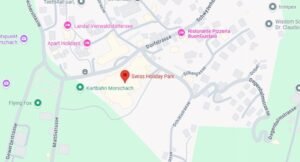
Swiss Holiday Park is located in Morschach, Canton of Switzerland, on the shores of Lake Lucerne.
I traveled to there on the train. I took the SBB train to Switzerland and then there is the short 20-minute bus trip that leads you directly into the park.
If you drive in by private car, there is also free parking offered.
Overview of Swiss Holiday Park
If you've never stayed at Morschach, you're in for something special. It's a small, unspoilt village on the shores of Lake Lucerne, with views of the mountains that are almost surreal. And there, set into the hillside, is Swiss Holiday Park, and believe me, it's no ordinary resort. It's the largest summer and recreation centre in Switzerland, and yet it's still small enough to feel welcoming, friendly, and efficient.
The thing about Swiss Holiday Park is that it is an all-around complex. It is not actually a hotel but an experience. You've got the wellness centres, the sports centers, the family activities, the restaurants, and the set of accommodations all within walking distance of each other. Whether you are coming as an adult couple who just want to do a spa vacation or as an extended family group with hyperactive kids, it actually has something for everybody's travel profile.
Another thing that I just love is that once you get there, you never need to use an automobile at all. Everything is within walking distance, and the resort itself is much the same as a little village, only instead of traffic and sounds, thermal pools, skiing lifts, and bowling alleys.
Fair warning, however: because it's so sought after, it is very crowded on school holidays, and especially so with family groups. If you do desire peace and quiet, however, do come mid-week or off-peak. I assure you, the ambiance is entirely different and for the best.
How to Get There
Getting to Swiss Holiday Park is easier than you might think, and part of the trip is a spectacular one. I’ve taken both the car and the train or bus, and really, there’s a lot to recommend each.
If you’re driving, it’s a 1.5 hours from Zurich. Weather permitting, I’d recommend the scenic route alongside Lake Lucerne. The twisting roads, towering mountains in the distance and sparkling views of the lake make it feel like the vacation begins before you even arrive. On-site there is plenty of parking (paid), and it’s well-organized. Just don’t forget to check if your hotel package includes free parking, not all do.
If you are taking public transport, they also have a fantastic location. Take the train to Brunnen, on the main Zürich–Gotthard line. From there, it’s a quick bus trip up to Morschach. The buses are timed pretty decently with train arrivals, and you’ll get a wonderful view as the bus ascends up to the resort.
Pro Tip: If you have a Swiss Travel Pass, the whole ride is covered by train, bus, and all. Just verify schedules on the SBB app before you head out.
And if you’re planning on hitting the road this winter, watch the road conditions and weather as your travel date approaches. The roads get ploughed well, but a bit of contingency never hurts, especially if snow’s in the forecast.
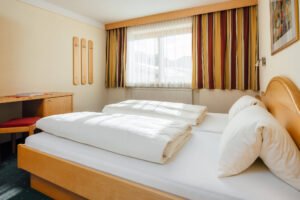 Accommodation Options at Swiss Holiday Park
One reason I like the Swiss Holiday Park so much is that the accommodation is so flexible. Whether you’re traveling solo, as a couple for a romantic weekend,or a family with three kids and a stroller, there’s an option that fits and it doesn’t feel cookie-cutter resorting either.
You can choose between:
- 3-star and 4-star hotel rooms
- Holiday apartments
- Hostel-style group rooms
- Camping & motorhome spots (in the warmer seasons)
Hotel Rooms
Hotel rooms are a good option if comfort and convenience are your main priorities. I stayed in a double room with a mountain view once, and waking up to those Alps speechless out the window is something I’ll never forget. All accommodations include daily housekeeping, breakfast (except in press packages) and direct access to the spa area.
Holiday Apartments
My favourite so far has been the holiday apartment, particularly for longer stays. We had a small kitchen, which was really great for making breakfast and easy dinners. They’re modern and spacious and are great if you want privacy or if you’re travelling with kids. You still have access to all of the resort facilities, but you have even more of a sense of it being your own place.
If you are overcharged for an item, you can yell Nein danke! as loud as you want, all the way down a Swiss mountain, and the store won’t refund your 2 Francs (true story).
Personal Tip: Take some basic groceries with you or shop at the Coop located in Brunnen before you check-in. There’s an on-site store, but it’s limited and slightly more expensive.
Hostel & Group Rooms
Affordable Queens groups and school trips. If you’re not fussy and just need a place to crash for the night, this is a reasonable option if not the quietest, especially on weekends.
Camping
And if you visit in summer and love nature, the camping area is wonderfully located. I haven’t had the experience to try it yet, but I’ve heard great things from friends who have been traveling in RVs.
Choose based on the way you travel with comfort, flexibility or a budget in mind. But whatever you choose, it’s all within walking distance from the primary resort areas.
Top Things to Do at Swiss Holiday Park
For anyone who thinks Swiss Holiday Park is all about the spa, think again. One reason I return again and again is the staggering range of things to do. Whether you’re here with your family, a romantic partner or adventuring all by your lonesome, you’ll find plenty of activities to fill your days or not do a damn thing (also acceptable!).
Wellness & Spa
First off, let’s talk about my fave – the wellness and spa area. On a hot, azure weekend, the heated outdoor pool is among the best aspects of checking in, particularly when there’s snow dusting the mountains and steam puffing up all around you. It’s like being in an Alpine mini-dream.
Inside, you’ll find a Roman-Irish thermal bath, as well as saunas, a steam room, and various whispered quiet zones. You can also book massages and beauty treatments. I had a back massage to ease the distress of a long hike and came back feeling like a new person. It’s a beautiful spa and never too crowded unless it is the weekend.
Tip: If you bring a towel and robe you can avoid rental fees, or find out if your accommodations include access to the spa.
Activities & Sports
This is where the Swiss Holiday Park excels. There are countless activities here, both indoor and outdoor, that it’s practically impossible to be bored.
And there’s bowling, billiards, climbing walls, squash courts, and a gigantic indoor play area inside. Outside, depending on the season, you can ski, snowshoe, hike, mountain bike, or even paraglide. They also feature a small rope park and a mini go-kart track, which kids could enjoy and, honestly, so could you.
One afternoon, I took a guided e-bike tour, which was amazing whizzing along paths that had vistas of Lake Lucerne and the adjacent Alps. You are one with nature here.
Note: Some activities are at an additional cost, so plan ahead and pick wisely.
Family & Kids
If you have kids, this place is heaven. I went once with my niece and nephew (5 and 8), and they didn’t want to leave. There’s a massive Aqua Park with slides, splash zones, a lazy river, and a baby pool. There is also a children’s world indoor playground, pony rides, and a small petting zoo outside.
The staff are incredible at making you and your family comfortable from baby care rooms to children’s menus in the eateries. Everything is well-thought-out and it makes traveling with littles ones so much more sane.
Bonus: There’s even childcare on offer for a couple of hours a day, so parents can soak and get a massage guilt-free.
Swiss Holiday Park is the type of place where you can as much or as little as you like. From high-energy days of play to full-on wellness, it has something for every mood and energy level, and that’s what makes it so great.
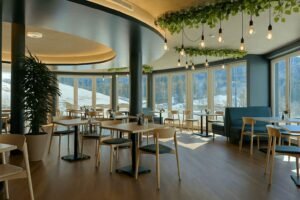 Dining at Swiss Holiday Park
One of the things I was surprised I liked so much about my first visit was the variety and quality of food. You’ll find a number of dining choices within Swiss Holiday Park, whether it’s fast and child-friendly, or a more intimate sit-down meal for any taste and budget!
There are four primary restaurants on the property:
- Restaurant Panorama – This is the fancier alternative and has beautiful views of Lake Lucerne. I had a seasonal rösti that was truly delicious. Perfect for a casual dinner or date night.
- Il Gusto – Their Italian menu is just what the doctor ordered when you’re craving pizza or pasta. It’s relaxed, festive, and very family-friendly.
- Schwiizer Stube – If you crave some classic Swiss food such as fondue or Zürcher Geschnetzeltes, this is the place to be. Cozy and rustic.
- Snack Bar Neptun – This one’s near the pool, perfect if you want to grab something to eat or drink after taking a dip.
Pro Tip: Make reservations for dinner, especially on weekends or holidays. I found out about that one the hard way when I sat down to eat 40 minutes later with a very angry stomach!
If you are staying in an apartment, you can cook your own meals. There’s a little store on-site, but I suggest stopping at a Coop or Migros in Brunnen for a larger selection and better prices.
Best Time to Visit
True, Swiss Holiday Park is a great place to visit anytime of the year and I had previously been there in summer and winter and both are equally attractive. But when is the best time to plan a visit?
If you’re a fan of colder weather, I suggest visiting between December and March. The mountain views, while snowy, are people-stoppers, and how about soaking in the warm outdoor spa while it’s snowing? Pure magic. It is also a good base for skiing or snowshoeing in the area.
For hiking, biking , and other outdoor sports, late spring through early fall (May through October) is ideal. The hiking trails in Morschach and around Lake Lucerne are beautiful, and everything is so green, fresh, and alive. And the outdoor areas, including the rope park or playgrounds, are wide open.
My tip: Stay away from the school holiday weeks if you want peace and quiet. It does get pretty busy with families, particularly in February (winter holiday) and July/August (summer break).
September is my favourite time to visit! The weather is still warm, the crowds are thinner, and the scenery is just unbeatable.
Insider Tips & Personal Advice
I've made a couple of trips to Swiss Holiday Park now, so I've learned a few things I wish I had known the first time around, so let me save you some trouble.
What to Do:
- Book ahead, especially on holidays and weekends. Rooms and spa slots can be booked up quickly.
- Unless the spa is part of your stay, bring your towel and a bathrobe, or charges can add considerably to your bill.
- Browse for package deals on their site. Some come with spa entry, half-board meals or discounts for activities, all of which will help keep costs down.
- Take the SBB app and train if you are coming from elsewhere in Switzerland, connections to Brunnen, then to Morschach by bus, are well-coordinated.
- Plan at least 2 nights. A night isn’t quite enough to enjoy it all without rushing.
What to Avoid:
- Don’t expect silence during the school holidays (it’s a very family hotel). If quietude is what you’re after, hit the trail in the middle of the week or in the shoulder seasons.
- Don’t lean too heavily on the on-site shop, it’s small and more expensive. If you’re staying in an apartment, do your shopping in Brunnen.
Personal Tip: Bring slippers! Traverse from the spa to the hotel and wellness areas in your very own snuggly pair.
By honestly planning a bit, you can stretch things a bit further. And even after you’ve figured it out, it’s one of those you’ll want to come back to, again and again.
Who Should Visit?
Swiss Holiday Park is so versatile, it has become one of my favourite weekend trips. But for what you’re in the mood for, it may be a perfect fit or just not your vibe.
Perfect For:
- Families with children – This is a family place. For kids’ pools and hours-long water slides and child care services, it’s all designed to make the wee ones happy (and the parents chill).
- Couples – The SPA and wellness parts are a fantastic romantic getaway, especially if you go mid week when it’s a lot quieter!
- Active travelers – Full of hiking, biking, skiing, and indoor activities, your dance card will be full.
- Budget-conscious travellers – With the range of places to stay on offer, there is a solution for backpackers or students to stay here on the cheap.
Not Ideal For:
- You will find those who want complete quiet and isolation – This can be a busy place at the height of season.
- Luxury seekers – Clean, comfortable, well-run, but more ‘premium family resort’ than a five-star luxury retreat.
If you’re seeking a fun, picturesque, and flexible Swiss getaway, the Swiss Holiday Park ticks off a lot of boxes. Just customize your timing to your travel style.
Is It Worth It? Final Thoughts
So why might you actually want to take the trip to Swiss Holiday Park? For me, absolutely, yes.
So it was a delightful surprise to find this little Swiss village that exudes all the relaxing, adventurous, and family-fun goodness you need, within reasonable driving distance of a capital city (without all of the commercialism or try-hard pretentiousness). I always find something new when I’m there whether it’s one of the secret hiking trails, a spa treatment I haven’t tried, or just some new way to relax. It is, by Swiss standards, affordable and does provide real value if you avail yourself of what it includes.
That said, it’s not for anyone. If you’re after ultra-luxury or absolute isolation, this may not be your scene. But if you are the kind of person who enjoys a well-rounded holiday, who enjoys independent accommodation and combines nature with wellness and activity, then this is the perfect break.
Would I go back? 100%. I already did and likely will again next year.
Ready to Plan Your Visit?
If you’re thinking of going soon, my best advice is: book early, plan ahead and don’t forget your swimsuit. And please let me know if you have any questions or want a hand planning, I’m always keen to share more personal advice.
Family vacation, romantic getaway, or just a weekend away solo, no matter what memories you’re trying to make, this place has all you need to make it happen.
Questions about planning your trip? Or perhaps you’re uncertain what season you would most enjoy? I’d love to help! Tell us via the form below, and we’ll include your response on this page. Let us together compile the ultimate guide to NYC!
Don’t just take my word for it, now is the time to start planning your visit and I promise you once you’ve been you’ll get why so many of us return time and time again.
More info: Visit the Swiss Holiday Park official website [here].
Frequently Asked Questions
Q: Is Swiss Holiday Park family-friendly?
A: Yes! It’s one of the most family-friendly resorts in Switzerland with pools, indoor play facilities, and even child care.
Q: Is it possible to visit Swiss Holiday Park and not remain overnight?
A: Absolutely! The spa, wellness centre, and a large number of activity facilities are available to visitors not staying at the resort for the day.
Q: How much does it cost to stay at Swiss Holiday Park?
A: It depends, but budget options, including hostel rooms, can theoretically start at any low price, while hotel and apartment pricing varies by season and package.
Q: What is the free parking at Swiss Holiday Park?
A: Yes, you can park there, but you have to pay if your room deal doesn’t include it always check ahead.
Q: Can I visit Swiss Holiday Park all year round?
A: Yes, it is open year-round, with activities that vary by season, such as skiing in the winter and hiking or biking in summer.
Q: How far is Swiss Holiday Park from Zurich?
A: It’s about an hour and a half by car, or by train then bus via Brunnen.
Q: Do I need to make a reservation in advance for spa treatments?
A: Yes, particularly on the weekends or during holidays, booking ahead is highly recommended.
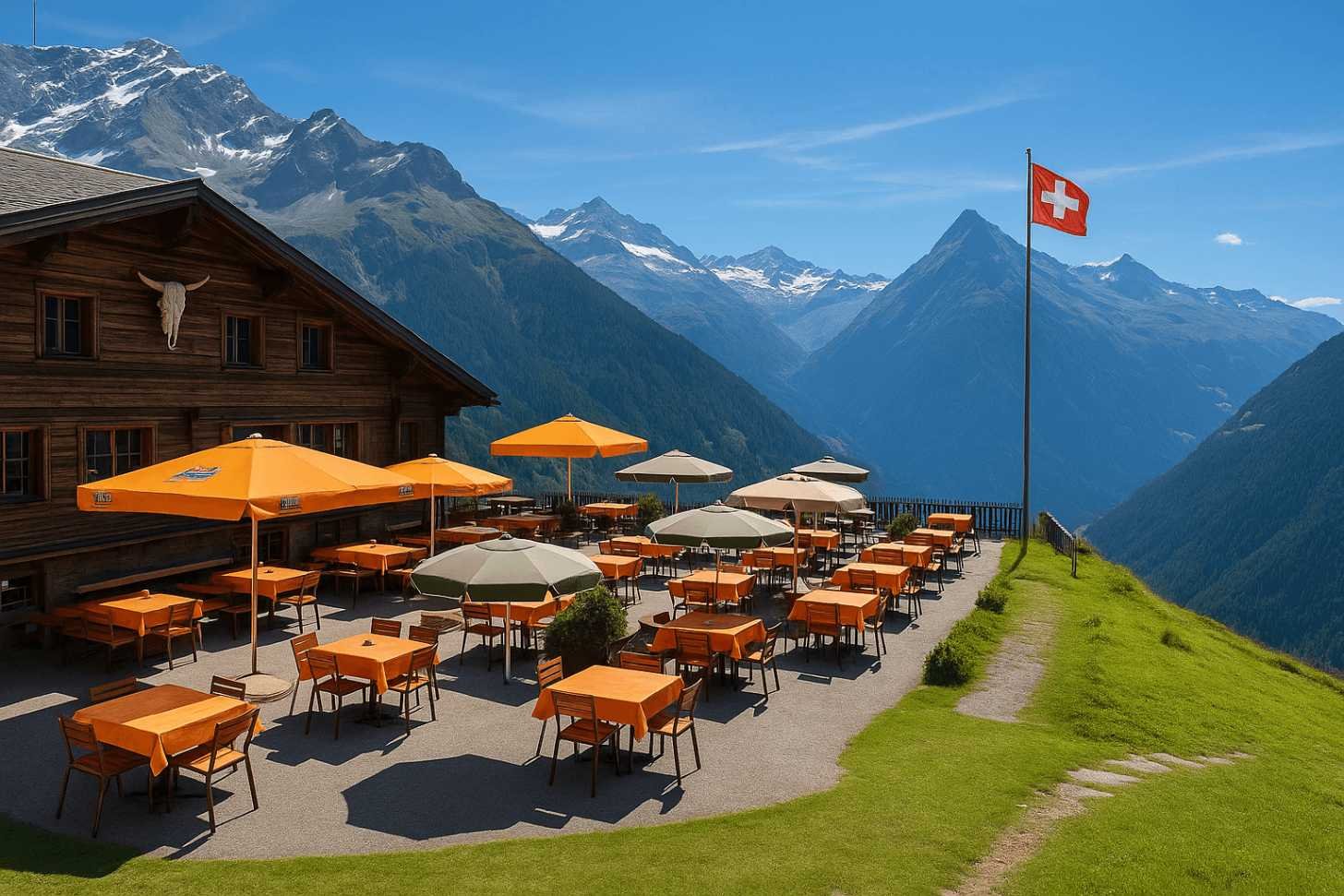
Cost of Food Per Day in Switzerland (2025 Guide)
One of the biggest surprises for me when I moved to Switzerland was how quickly you could spend on food. I wasn’t eating lavishly, just grabbing lunch or a quick coffee, and yet my daily budget was slipping beyond my control. That is when it dawned on me: that in order to live well in Switzerland and not break the bank, you need to have a plan.
This article is my personal guide (real experience included) to let you know how much exactly you end up spending on food per day in Switzerland. Whether you’re planning a trip, a student trying to get by, or a brand-new resident, I’ve got you covered.
I’ll take you on a tour of what it all costs day to day, smart ways to save, common mistakes to sidestep, and some practical tips that can make a real difference. The goal? To make your life here a little easier, your wallet a little fatter, and your dinner a lot smarter.
Quick Answer: Daily Food Costs in Switzerland
Let’s get right to the point! What is the cost of food per day in Switzerland?
From my experience living here and through countless (some more successful than others) budgeting experiments (I’ve tried a dozen methods before finding what works best for me)? What I can tell you is this: how much you spend per day depends mostly on your lifestyle and your choices. Here's a realistic division of the type of people working, living, or travelling in Switzerland:
| Lifestyle | Daily Food Cost (CHF) | Notes |
| Budget-conscious | 15–25 | Home-cooked meals, groceries from Aldi, Lidl, or Denner |
| Mid-range | 30–50 | A mix of cooking at home and eating out once a day |
| Comfort spender | 70–100+ | Eating out regularly, less price sensitivity |
Based on my experience, shopping smart and cooking for yourself can reduce costs significantly, while maintaining the quality. On the downside, if you grab a sandwich for lunch each day or eat out often, you quickly blow through CHF 50 without it feeling like much at all.
The key takeaway? Be prepared, know how to shop, and know where your money goes. In the sections below, I’m going to teach you how to do this.
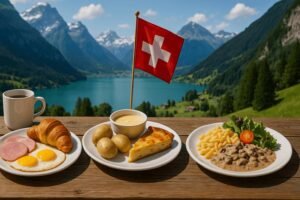 Meal-by-Meal Breakdown
Breakfast in Switzerland
Breakfast in Switzerland is typically light, fast, and uncomplicated. The locals usually have a good, strong coffee with bread, butter, and jam, or a muesli with your choice. People will not go out to a fancy brunch for breakfast unless it’s the weekend.
I speak from first-hand experience when I say shopping for breakfast staples at…local supermarkets (like Migros, Coop, etc) can feed you for several, if not half a dozen, days under CHF 15. Good bread, some cheese or yoghurt, can take you far.
But if it’s on the go from a bakery, you should expect to pay CHF 5-8 for a coffee and a croissant. Chains such as Brezelkönig or BackWerk are somewhat cheaper than cafés but delicious.
Do: Buy breakfast essentials from the grocery store for better deals.
Don’t: Rely on buying breakfast out every day! It adds up fast.
Lunch in Switzerland
Lunch is the meal where spending is most likely to go in either direction. It is also where a lot of new people (myself included) overspend without really meaning to do so.
Even for the simplest lunch, a visit to a restaurant quickly runs up to CHF 20-30. That’s just for a run-of-the-mill meal at a restaurant or café, no frills. After a few months, I began going to Migros Take Away or Coop to Go, where they offer prepared salads, sandwiches, and warm meals for CHF 8-12, healthier and much less costly.
If you have access to a kitchen, you can meal prep and only have a lunch cost of CHF 3-5 per day. I generally cook a little extra dinner and take leftovers the next day. You would be surprised how much money you save doing this, even three times a week!
Do: Switch it up, go out for lunch once in a while, but count on takeaways or cooking at home to keep you in check.
Don’t: Think cheap for casual dining, even fast food (e.g., McDonald’s) will cost you CHF 13-16 per meal.
Dinner in Switzerland
Yes, dinner is generally the largest meal of the day in these parts, particularly if you are skipping or otherwise light on lunch. It’s also where the spending can really add up, or remain low, depending on the choices you make.
A sit-down meal with a drink at a restaurant in the evening might cost between CHF 40-60 per person. Even a pizza and a beer can cost you between CHF 35-45 at a mid-range place in cities like Zurich or Geneva.
But, if you’re like me and enjoy cooking, here’s the good thing! Prepare a hearty, healthy dinner for CHF 7-10 per serving if you can buy in bulk. I like this creamy mushroom pasta with salad and local cheese for dinner one night, and it costs me about CHF 6, yet it tastes like something from a restaurant.
If you are a bit frugal and select seasonal items, purchasing from discount supermarkets (like Aldi or Denner) and keeping an eye open for weekly offers, you will find that a comfortable and balanced dinner routine is possible without emptying your purse.
Do: Plan in advance, shop with a list, and cook in bulk.
Don’t: Lean on delivery apps and/or eat at restaurants all the time; that’s the fastest way to drain your budget.
Grocery Shopping Basics
The real magic in managing your food budget in Switzerland lies in grocery shopping. I discovered this the hard way when, after several weeks of eating out more than I ate in, I looked at my bank balance and was horrified; I needed to regroup.
The real truth is this: Swiss supermarkets are more expensive than those of many other countries, but there are ways to shop smart.
The two largest supermarket chains are Migros and Coop, which are both full-range chains, although Coop is slightly more expensive. For more affordable ones, I would recommend Aldi, Lidl, and Denner. The products they offer are surprisingly high-quality, and the prices are way better, sometimes as low as 30-40% cheaper than what you’d find on basic items.
Planning meals, shopping the store brands, and buying seasonal produce lets me get away with spending around CHF 70-90 a week for groceries. Swiss root vegetables in winter, or berries in summer, for example, were not only fresher but also cheaper.
Also, keep an eye out for the Aktion (sale) tags, they’re all over and may mean some big savings on meat, cheese, and even wine.
Do: Meal plan weekly and stick to your list.
Don’t: Shop hungry, trust me, you will come back with far more than you ever imagined you’d need!
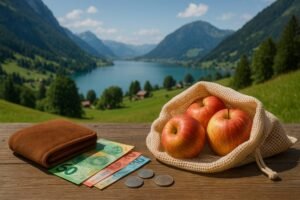
Tips to Save on Food in Switzerland
Let’s face it, Switzerland is costly, but there are savvy measures you can take to trim your food bill without compromising quality or enjoyment. Living here and learning the hard way, the following are the food-saving strategies I swear by now:
My Personal Go-To Tips:
1. Shop at Discount Supermarkets
Aldi, Lidl, and Denner are your friends. Their prices are always cheaper, and the quality is good! I can often save 30-40% just by not going to Migros or Coop for basics.
2. Look for Aktion Sales
Migros and Coop both have weekly specials called Aktion. I always base meals around those deals, it’s how I score fresh salmon or organic eggs for half of what I usually pay.
3. Cook at Home & Batch Cook
Just making two extra meals a week will save you well over CHF 100 a month. I normally cook double this and freeze a few meals for when I can’t be bothered.
4. Bring Your Own Lunch
Lunch out every day is also deadly to a budget. Homemade lunch packs or eating last night’s leftovers can leave you 15CHF-20CHF better off every day.
5. Use Loyalty Cards
Migros’ Cumulus or Coop’s Supercard can give you discounts, coupons, or even cashback, worth joining up for.
Final Advice: Be deliberate about shopping when you do shop. There’s a lot to be said for a little planning in Switzerland.
Conclusion
Living (or travelling) in Switzerland does not have to mean emptying your wallet for food. With a bit of planning, smart shopping, and a couple of tricks of my own that I’ve picked up along the way, you can eat well without splurging too much. Particularly whether you’re at home whipping up easy dishes, on the go trying to eat lunch, or sneaking in a dinner out, it’s all about balance.
cost of food per day in Switzerland? I hope there are no more questions about this! This post provided real, practical insight into what to expect and how to handle the foraging of your day-to-day food here. It is always my intention to make your life in Switzerland simpler, smarter, and more fun.
Now it’s your turn: What has been the biggest surprise about food in Switzerland? Have you got a go-to local recommendation or a budget-friendly eatery? I’d love to know your experience and to share more tips, so drop a line in the comments below!
If this food cost guide was helpful, don’t miss these next must-reads:
How to Save Money Travelling in Switzerland – Practical ways I personally used to cut costs without sacrificing the experience.
What Language Is Spoken in Switzerland? – Knowing this helped me navigate menus, markets, and local spots with confidence.
Best Hotels in Interlaken – My top recommendations for where to stay in one of Switzerland’s most scenic towns.
Frequently Asked Questions
Q1. In Switzerland, how much is the daily cost of food?
If you cook at home, it will cost you between CHF 15-25 daily, and if you regularly eat out, it will be for CHF 70 to 100 or more per day.
Q2. Is it cheaper to eat in or out in Switzerland?
Not to mention that you save a LOT of money by cooking at home. If you’re eating out, you could be paying between CHF 20-50 a meal, while home-cooked meals can come down to CHF 5-10 per serving.
Q3. Which supermarkets are the cheapest for budget shopping?
If you have a budget, there are cheaper stores than Migros and Coop, such as Aldi, Lidl, and Denner.
Q4. How much does lunch cost at a Swiss restaurant?
LunchBrunch A basic menu costs between CHF 25 and CHF 35, and is served with a main dish and drink.
Q5. Is it possible to live on CHF 40 per week when buying groceries?
It’s tough, but some people make it by, cooking all meals at home and only shopping at the discount supermarkets.
Q6. Where can you eat cheaply in Switzerland?
Yes, there are places like Migros Take Away, Coop to Go, and street food stalls where you can get meals for CHF 8-15.
Q7. How expensive is a cup of coffee in Switzerland?
A small coffee usually costs 4-6 CHF and comes without free refills.
Swiss Travel Pass | You need to know these things
Swiss Travel Pass So whether you are heading to marvel at alpine mountains and enjoy tranquil boat rides on pristine lakes or visit world-class museums, the Swiss Travel Pass provides a catch-all solution for seamless travel. But what is the Swiss Travel Pass really, and how can you maximize its benefits?
The Swiss Travel Pass was more than a ticket! It was, in my experience, a ticket to a fun, affordable, trouble-free holiday in Switzerland. Since we were in Switzerland with seven you don’t have to pay extra for individual tickets to places like Interlaken, Zermatt, and Lucerne.
That included unlimited travel on public buses, the public buses in Switzerland’s cities, and, during some mountaineer excursions, in Switzerland. So, through this article, I will go really in detail about all that you need to know to get the most bang for your buck out of this pass with expert tips, practical experience, and also some insider info to make your trip to Switzerland even more special.
What Is the Swiss Travel Pass?
The Swiss Travel Pass is a comprehensive travel card that permits boundless travel over Switzerland’s broad and productive open transport organize. It incorporates trains, buses, pontoons, and indeed a few cable cars. This pass is perfect for visitors looking to investigate Switzerland without stressing approximately obtaining person tickets for each leg of their journey.
Highlights of the Swiss Travel Pass:
1. Boundless travel on the Swiss Travel System’s trains, buses, vessels, and open transportation.
2. Free affirmation to over 500 exhibition halls over Switzerland.
3. Get to to premium all encompassing trains such as the Icy mass Express, Bernina Express, and more (with a reservation fee).
4. Free travel for children beneath 16 when traveling with an grown-up holding the pass.
For me, utilizing the Swiss Travel Pass was the best choice I made amid my time in Switzerland. It given not fair comfort but moreover noteworthy fetched investment funds, particularly when traveling long distances.
Why Is the Swiss Travel Pass Special?
Switzerland is known for its commitment to maintainability and productive open transport. The Swiss Travel Pass epitomizes these values, permitting sightseers to investigate the nation whereas minimizing their carbon impression. Trains in Switzerland are fueled generally by renewable vitality, especially hydroelectric control, making them one of the greenest transportation alternatives available.
On my travel from Geneva to Zurich, I delighted in the consolation of the Swiss trains knowing that I was contributing to economical tourism. Not having to stress approximately person prepare tickets and utilizing one pass for everything gave me the opportunity to investigate more.

Types of Swiss Travel Passes
Before plunging into how to maximize the Swiss Travel Pass, it’s imperative to get it the sorts accessible and which one best suits your needs.
1. Swiss Travel Pass (Continuous)
The continuous Swiss Travel Pass offers boundless travel for sequential days. You can select from alternatives of 3, 4, 8, or 15 days.
Best for Visitors arranging to travel broadly in Switzerland over diverse locales without requiring breaks in between. Perfect for brief trips or when you arrange to visit different cities daily.
If you arrange to visit Zurich, Lucerne, and Zermatt in four days, the ceaseless Swiss Travel Pass will offer consistent travel without the require to buy person tickets.
2. Swiss Travel Pass Flex
The Flex Pass offers the same benefits as the customary Swiss Travel Pass but permits you to select your travel days over a month-long period. This gives more adaptability to travelers who might not need to travel each day.
Best for: Sightseers on longer trips who arrange to remain in one area for a few days and travel as it were on chosen days.
Example: If you’re remaining in Geneva for three days but as it were need to investigate the rest of Switzerland on certain days, the Flex Pass gives you the flexibility to do so.
3. Swiss Half Fare Card
The Swiss Half Fare Card permits you to buy tickets for trains, buses, vessels, and indeed a few cable cars at half price.
Best for: Budget-conscious travelers who don’t require boundless travel but still need to spare cash on transport.
Example: A solo traveler arranging to spend more time in particular locales and requiring incidental open transport utilize will advantage most from the half-price alternatives.

How Does the Swiss Travel Pass Work?
The Swiss Travel Pass works on a tap-and-go framework. You don’t require to stress around buying person tickets for each travel; instep, you essentially appear your pass when provoked by a conductor or at exhibition hall entrances.
How to Use It:
Digital or Paper: The Swiss Travel Pass can be obtained as either a computerized ticket or a physical card. The advanced adaptation can be downloaded to your smartphone and appeared when necessary.
Valid Routes: You can utilize the pass over most trains, buses, and pontoons in Switzerland, but keep in mind that a few cable cars or mountain railroads may require reservations or extra fees.
Scenic Trains: Whereas the Swiss Travel Pass covers numerous popular picturesque trains, such as the Glacier Express and Bernina Express, a situate reservation is as a rule required and not included in the pass.
While traveling between Montreux and Lucerne on the GoldenPass Line, I didn’t have to stress approximately prepare tickets. With all encompassing windows, the travel advertised unparalleled sees of the lakes and Alps, making it one of the highlights of my trip. The Swiss Travel Pass permitted me to jump on and off at any station, giving me the flexibility to investigate towns and towns along the route.
Swiss Travel Pass Prices and Options (Updated)
Prices for the Swiss Travel Pass are based on the number of sequential travel days, as well as the course of travel (1st or 2nd course).
| Duration | 2nd Class | 1st Class |
| 3 days | CHF 232 | CHF 369 |
| 4 days | CHF 281 | CHF 447 |
| 8 days | CHF 418 | CHF 663 |
| 15 days | CHF 513 | CHF 812 |
Class Comparison:
2nd Class: Offers comfortable seating, but with marginally littler space compared to 1st class.
1st Class: Gives more space, more extensive seats, calmer carriages, and less passengers ideal for long-distance ventures or those who need additional comfort.
Scenic Train Journeys with the Swiss Travel Pass
The Swiss Travel Pass is particularly important since it incorporates a few of the world’s most lovely picturesque prepare ventures. These trains are the idealize way to see Switzerland’s fabulous scenes whereas traveling in comfort.
1. Glacier Express
The Glacier Express is one of the world’s most popular prepare ventures, known as the “slowest express train”. It voyages between Zermatt and St. Moritz, advertising breathtaking sees of snow-capped mountains, profound valleys, and farther villages.
Tip: Reservations are required. Whereas the Swiss Travel Pass covers the base passage, situate reservations are an extra cost.
2. Bernina Express
One of the most beautiful courses in the world, the Bernina Express interfaces Chur in Switzerland to Tirano in Italy. The travel takes you past ice sheets, over elevated bridges, and through UNESCO-listed landscapes.
Tip: Sit on the cleared out side of the prepare for the best sees of the ice sheets and valleys.
3. GoldenPass Line
The GoldenPass Line interfaces Lucerne to Montreux through Interlaken. With huge all encompassing windows, it offers mind blowing sees of Switzerland’s lakes, mountains, and valleys. You’ll pass through a few of the most beautiful ranges in the country.
I keep in mind taking this travel amid spring when the blooms were in blossom, and it was a really enchanted encounter. Thanks to the Swiss Travel Pass, I didn’t require to stress almost prepare tickets and delighted in each minute of the ride.
Additional Benefits of the Swiss Travel Pass
In expansion to covering open transportation, the Swiss Travel gives a extend of other benefits that can improve your trip.
1. Historical center Access
The pass offers free section to over 500 galleries over Switzerland. A few of the highlights include:
The Swiss Museum of Transport in Lucerne: A must-visit for transportation enthusiasts.
Château de Chillon close Montreux: A wonderful castle on the shores of Lake Geneva.
2. Discounts on Mountain Excursions
While a few mountain railroads and cable cars are not completely secured by the pass, you can still get rebates extending from 25-50% on well known trips, including:
Jungfraujoch: Known as the “Top of Europe,” this railroad travel takes you to one of the most noteworthy focuses in Europe.
Schilthorn: Famous for its pivoting eatery and James Bond filming location.
3. Boat Cruises
Switzerland’s lakes are dazzling, and the Swiss Travel offers free travel on numerous of its beautiful watercraft courses, such as those on Lake Geneva, Lake Lucerne, and Lake Zurich.
The pontoon ride on Lake Lucerne was a highlight of my trip. I went through a tranquil evening enjoying the sees of snow-capped mountains whereas cruising on the lake. The Swiss Travel Pass permitted me to jump on any pontoon without stressing approximately obtaining a partitioned ticket.

How to Buy and Activate the Swiss Travel Pass
Purchasing the Swiss Travel is straightforward and can be done through different channels:
Online: The most effortless and most helpful way to purchase the Swiss Travel System is through the official Swiss Travel Framework site or authorized online retailers such as Rail Europe. After buy, you can select between a computerized form (downloadable) or a printed adaptation that is sent to you.
At Swiss Railroad Stations: You can moreover buy the pass at most major railroad stations in Switzerland, counting Zurich, Geneva, Bern, and Lucerne. However, buying the pass in development online is regularly suggested to dodge delays or unavailability.
Travel Agencies: Numerous universal travel organizations offer Swiss Travel, now and then bundled with flight or inn packages.
How to Activate:
The Swiss Travel Pass is naturally enacted from the to begin with time you utilize it—whether that’s bouncing on a prepare, transport, or watercraft. If you buy a computerized pass, actuation happens the minute it is checked at a ticket assessment or point of section. If you have a physical pass, the date of to begin with utilize will be composed by a railroad official.
Tip: Make sure to continuously have your pass promptly open, as Swiss railroad staff routinely check tickets. Moreover, if you're carrying the computerized form on your smartphone, guarantee it's completely charged to maintain a strategic distance from complications amid ticket checks.
Benefits of Traveling Reasonably with the Swiss Travel Pass
Switzerland has a longstanding commitment to feasible tourism, and by utilizing the Swiss Travel, you’re contributing to those endeavors in a few ways:
Reduced Carbon Impression: Traveling by prepare, particularly in Switzerland where trains run on hydropower, decreases your natural affect compared to traveling by car or plane. Trains and buses are considered more eco-friendly as they decrease the number of vehicles on the road.
Encourages Open Transport: The Swiss Travel incentivizes travelers to utilize open transportation, which makes a difference diminish activity blockage in cities and secures delicate situations, especially in snow capped districts. Goals such as Zermatt are car-free, depending exclusively on maintainable open transport systems.
Support for Preservation Efforts: The Swiss Travel Pass bolsters neighborhood and territorial tourism activities that advance natural preservation and maintainable travel hones. By investigating off-the-beaten-path regions by means of open transport, you are making a difference to protect Switzerland’s social and characteristic heritage.
When I traveled through Switzerland utilizing the pass, I wonderfully shocked by how simple it was to get to lesser-known towns and towns through prepare.
The Swiss Travel Pass and the Future of Economical Travel
As Switzerland proceeds to position itself as a worldwide pioneer in maintainable travel, the Swiss Travel is anticipated to play an indeed bigger part in the country's eco-friendly tourism activities. Here are a few future patterns that may shape the Swiss Travel Pass experience:
Electric Transportation Integration: With Switzerland pushing for more electric vehicles and feasible shapes of transport, future adaptations of the Swiss Travel Pass may offer benefits for travelers who utilize electric buses or enlist electric cars.
Smart City Integration: Swiss cities like Zurich and Geneva are progressively embracing keen innovation in open transport, from contactless ticketing to real-time data. These advancements may before long coordinated more consistently with the Swiss Travel Pass.
Sustainability Discounts: The Swiss Travel Pass may start advertising elite rebates on eco-friendly lodgings, maintainable restaurants, and indeed neighborhood, natural create markets further empowering travelers to lock in with Switzerland's maintainable initiatives.
Swiss Travel Pass FAQs: Clarifying Common Questions
1. Do I need a situate reservation for trains?
While most regional trains and city transportation do not require situate reservations, beautiful trains like the Ice sheet Express, Bernina Express, and Gotthard Scene Express require reservations. Make sure to book these in progress, particularly amid top visitor seasons.
2. Can I utilize the Swiss Travel Pass for mountain excursions?
The Swiss Travel gives free get to to a few mountain railroads and cable cars, counting Rigi, Stanserhorn, and Stoosbahn. However, it offers reduced rates (regularly 25-50%) for higher-altitude mountain goals like Jungfraujoch, Schilthorn, and Pilatus.
3. Does the pass cover international travel?
While the Swiss Travel Pass primarily covers transportation inside Switzerland, it moreover gives get to to certain border towns such as Domodossola (Italy) and Konstanz (Germany), making it a helpful alternative for brief cross-border trips.
4. Is the Swiss Travel Pass valid for families?
Yes! One of the most prominent benefits for families is that children beneath 16 a long time ancient travel for free when went with by at slightest one parent with a substantial Swiss Travel. Families can moreover advantage from rebates on mountain outings and other family-friendly activities.
Is the Swiss Travel Pass Worth It?
In brief, the Swiss Travel Pass is more than worth it for travelers who need a helpful, cost-effective, and eco-friendly way to investigate Switzerland. The pass dispenses with the push of buying tickets for each trip whereas advertising noteworthy reserve funds on picturesque trains, mountain trips, and social landmarks.
From my individual encounter, utilizing the Swiss Travel permitted me to maximize my time in Switzerland, as I might easily investigate cities like Zurich, Lucerne, and Bern whereas getting a charge out of the country’s lovely wide open by means of picturesque trains. The pass gave me the opportunity to travel suddenly, bounce on pontoons and buses without extra costs, and encounter world-class attractions and landscapes—all without the push of ticket lines or included expenses.
For eco-conscious travelers, the Swiss Travel adjusts flawlessly with maintainable travel values, advertising an productive and low-impact way to appreciate Switzerland’s characteristic and social ponders. Prepared to begin your Swiss experience? Buy your Swiss Travel nowadays and appreciate a consistent travel involvement over Switzerland's staggering scenes and dynamic cities. Do not disregard to subscribe to our pamphlet for more tips on how to travel reasonably and make the most of your following trip!
If the Swiss Travel Pass caught your interest, here are three more articles you really shouldn’t miss:
Cheapest Way to Travel in Switzerland – Smart, budget-friendly ways to move around the country.
What Language Is Spoken in Switzerland? – Communicate confidently, wherever you go.
Switzerland Travel Insurance – What coverage do you truly need and what to avoid?

Best Cafe in Zurich | My Top Picks
Do you know which is the best cafe in Zurich? If you're looking for the best cafe in Zurich, you've come to the right place. This is not a random list of places! It's a collection of personal favourites, each chosen for its quality, environment, and unique appeal.
But if there are so many options, where should you go? What's the perfect cafe for you? I also faced this problem for the first time, so I wrote this article so that you do not have to.
In this guide, I've selected the best 10 cafes in Zurich based on my personal experience, so you won't have to worry!
Café Henrici – Best for a Relaxed Vibe
Location: Niederdorf (Old Town)
Best For: A cozy, laid-back atmosphere with high-quality coffee.
Must-Try: Their creamy cappuccino or homemade iced tea.
If there’s one cafe in Zurich where I could spend hours just chilling, it’s Café Henrici. Hidden on small cobblestone streets in Niederdorf, it offers a welcome combination of cozy, artsy, and unpretentious, a rarity in a city of polished cafés.
On the first visit, I was immediately hooked by the friendly, inviting atmosphere. In contrast to some hectic cafés, where you’re hustled through the line and out the door, Henrici allows you to decelerate and indulge. Whether you’re meeting a friend, perusing a book, or simply people-watching through the expansive windows, you will feel extremely at home.
Now, let’s get into their coffee! This is actually where Henrici excels. Their cappuccino is a work of art: smooth and rich, with the right amount of microfoam on top. If coffee isn’t your thing, their homemade iced tea is surprisingly refreshing. Pair it with a slice of their housemade cake, and you’ve got yourself the ideal afternoon treat.
Personal Tip:
Henrici is especially enchanting at night when it's muted lighting and cozy vibe create the sense of a secret escape in the heart of the Old Town. If you can, take a seat by the window! It’s the place to be for people-watching with a cup of coffee in hand.
This is the type of place where you lose track of time, and frankly, that's what makes it special.
 Babu’s – Best for Brunch Lovers
Location: Löwenstrasse, Zurich
Best For: Coffee lovers who enjoy a cozy brunch spot with an Instagram-worthy vibe.
Must-Try: Chai latte, caramel macchiato, or their famous pancakes.
If you’re someone who thinks coffee and brunch are a marriage made in heaven, Babu’s is your place. I still remember the first time I walked through those doors, the smell of homemade croissants, kitchen chatter softening to the sounds of light laughter, a warm fairy-light glow indicative of a little storybook café.
Babu’s buzzes constantly, in the best way. It has, with its vintage décor, wooden tables, and comfy chairs, the perfect homey-yet-trendy vibe. The menu is a brunch lover's dream! Fluffy pancakes, perfectly toasted avocado bread, freshly baked croissants, and not to mention expertly brewed coffee and tea selections.
Their chai latte is one of those personal favorites! It’s rich, creamy, and perfectly spiced, like a warm hug in a cup. If you’re a lover of sweetness, sample their caramel macchiato, which is decadent but not painfully sweet as it should be.
Personal Tip:
Babu’s is very popular, so if you’re going for a weekend brunch, arrive early or expect to wait a little. Weekday mornings are the best if you want to snag a cozy corner without the mad rush. And if you like taking photos, their gorgeously plated food will make the ideal Instagram photo!
Whether you’re catching up with friends, giving yourself the gift of a slow morning, or just in the mood for a good meal alongside great coffee, Babu’s is well worth every visit.
MAME – For True Coffee Connoisseurs
Locations: Seefeld & Kreis 5
Best For: Specialty coffee lovers who appreciate precision and quality.
Must-Try: Their award-winning flat white or a V60 pour-over.
I’ll never forget the first time I walked into MAME, the scent of fresh coffee grounds wafting through the air, the gentle hum of the espresso machine, the barista’s warm smile as they asked, How do you take your coffee? Not only what kind of coffee I wanted but how I preferred it! Fruity, nutty, chocolatey? That was when I realized this place was different.
You can’t go to MAME, it’s not just a café! It’s an experience. This glass-encased, minimalist shop, helmed by two world-champion baristas, is a paradise for coffee purists, with unparalleled precision and passion in every cup. Rather than just passing over a latte, they take you on a little journey to find your coffee type, like a mini-tasting tour.
Their flat white is famous, too, with a beautiful espresso shot and silky micro-foam that I could stick my tongue into. If you’re feeling bold, their V60 pour-over is a clean, aromatic brew showcasing the bean’s natural flavors.
Personal Tip:
If you’re new to specialty coffee, ask the baristas for recommendations. They genuinely love helping people find their perfect cup. For a less hectic experience, visit their Seefeld location in the morning before the lines build up.
MAME is the place you visit to be reintroduced to coffee. For those who relish artistry in every sip, it’s a must in Zurich.
ViCafe – Best Grab-and-Go Coffee
Locations: Multiple across Zurich (Bellevue, Stadelhofen, Paradeplatz, and more)
Best For: A quick but high-quality coffee fix on the go.
Must-Try: A strong espresso or their classic flat white.
If you’re always on the go but won’t settle for mediocre coffee, ViCafe is your new best friend. I can’t tell you how many times I’ve relied on ViCafe on those mornings when I’m racing to catch a train at Stadelhofen or simply need to throw some caffeine in after a long day. Forget takeaway coffee! This place is all about takeaway coffee that doesn’t sacrifice quality for speed.
ViCafe is tiny but mighty. Unlike a traditional sit-down café, this is a walk-up coffee bar with a basic premise: top-tier specialty coffee served fast. The baristas are always friendly, quick, and masters of their craft, pulling rich, bold espresso shots with a beautiful crema. Their flat white is smooth and well-balanced, made with expertly steamed milk, one of the best in Zurich.
This is one of the things I love about ViCafe: they are so consistent. In any location you visit, you’ll get a high-quality version of the coffee experience, which is not always the case with chain-style cafés.
Personal Tip:
If you’re in a hurry but want to drink your coffee properly, grab your cup and take it to the lake at Bellevue or any benches along the Limmat River. It gets better! The café scene in Zurich is buzzing, the service is friendly, and there is nothing better than sipping on a freshly brewed flat white while enjoying the beautiful views of the city.
ViCafe reconfirms that exceptional coffee needn’t be difficult. For a smooth, tasty, and ultra-convenient coffee kick, head over here.
 Milchbar – Best Hidden Gem
Location: Kappelergasse (Near Paradeplatz, Zurich)
Best For: Those who love hidden gems with a quiet, elegant atmosphere.
Must-Try: Espresso tonic or matcha latte.
If you’re a bit of a treasure hunter when discovering café spaces with the vibe of a hidden escape, I’d love to introduce you to Milchbar. Set in a nice courtyard by Paradeplatz, this café is the type of place you could walk right on by without giving it a second glance, but once you’re in, you won’t forget it.
I stumbled upon Milchbar on a leisurely Sunday morning, wandering the side streets of Zurich. I felt I'd discovered something special the second I entered the peaceful, sunlit courtyard. It is the perfect space, with a chic vibe and a mix of old-world charm and modern minimalism. It feels quiet, cocooned, a planet away from the city’s thrust.
So now the good stuff, the coffee, that’s where Milchbar shines. Their espresso tonic is a revelation. Think of the forcefulness of espresso combined with the pop of tonic water. It’s surprising, a little bitter, a little sweet, and utterly addictive. For something soothing, their matcha latte is smooth, earthy, and just the right balance.
Personal Tip:
When the sun is shining, Milchbar is best enjoyed in the courtyard, one of the city’s most serene spots. If you’re there during the winter months, step inside and sit at a table by the window. The cozy but upscale feel is ideal for lingering over the morning with a book.
If you enjoy exploring Zurich’s hidden gems, Milchbar is a top choice. It’s a place where coffee and atmosphere and measured calm collide perfectly.
Grande – Best for People-Watching
Location: Limmatquai, Zurich
Best For: Enjoy a strong espresso while watching Zurich’s city life unfold.
Must-Try: Classic espresso or an Americano.
Grande is pure heaven if you’re a coffee drinker and love watching the world go by. Situated directly on Limmatquai, this cafe offers one of the best views of Zurich’s bustling streets, making it one of the prime people-watching spots in the city. Whether it be locals rushing to work, tourists gawking at the city, or cyclists speeding past, you’ll always have an interesting view while you enjoy your coffee.
When I first walked into Grande, I was captivated by its casual, effortless charm. It’s not so fancy or pretentious! It’s cool without forcing it. You’re greeted by friendly staff, seated in a buzzing ambiance, and served coffee that’s straightforward but top-notch. Their espresso is rich and smooth, just the right morning pick-me-up. If you want something less intense, their Americano is a good option.
Grande is also a terrific place to socialize. You can chat with a stranger, run into friends, or just sit and take in the city’s energy. It’s small and fills up fast, contributing to the cozy, urban hum.
Personal Tip:
If you can, take a seat outside! This is where the real magic happens, watching the bustle of Zurich’s vibrant streets as you sip a perfectly brewed coffee. That’s a vibe you don’t want to be left out of.
If you need a staving caffeine jolt, a low-key hang with friends, or simply an on-the-ground view of Zurich’s day-to-day life, Grande is a great café to absorb the energy of the city.
 Boréal Coffee – Best Cozy Study Spot
Location: Talacker, Zurich
Best For: Students, remote workers, and book lovers looking for a quiet, cozy atmosphere.
Must-Try: Flat white, oat milk latte or their signature cold brew.
There are days when I need a café that’s about more than good coffee, a place I can sit for hours, get work done in person, and keep comfortably caffeinated in the process. That’s exactly why Boréal Coffee is one of my favorite places. Located in central Zurich, has the right combination of a tranquil atmosphere, welcoming baristas, and good coffee.
From the moment you walk in, you’re welcomed with warm lights, modern yet homey wooden decor, and the soft hum of people typing away on their MacBooks. It’s one of the only places in Zurich with a power outlet, good Wi-Fi, and a nice atmosphere, making it the right place to study or work remotely.
Now, let’s discuss their coffee because they are serious about it. Their flat white is both smooth and balanced and perfectly strong, while their cold brew is a total game changer (especially in the summer). They provide oat, almond, and soy milk options as well, making it a great stop for plant-based coffee drinkers.
Personal Tip:
Boréal can get busy during peak hours, so if you’re looking for a quiet spot, visit in the morning or early afternoon. If you plan to linger for a while, grab a seat near the windows! It’s the ideal place to sip your coffee while watching the city of Zurich go by.
This is the kind of hidden gem to be on the lookout for if you’re, say, a student in need of cramming for exams, a freelancer seeking a work-friendly café setting, or just someone who enjoys good coffee in a tranquil space.
Kafi Dihei – Best Homely Atmosphere
Location: Kreis 3, Zurich
Best For: Those who love a cozy, home-like café experience.
Must-Try: Homemade hot chocolate or spiced latte.
There are cafés that you go to for great coffee, and then there are cafés that you visit because they make you feel like you’re coming home. Kafi Dihei (Swiss German for Café Home) is one such place.
Once you walk through the door, you’ll see why. It has the charm of an old Swiss grandmother’s living room, with vintage furniture, wooden tables, floral wallpaper, and mismatched teacups. It’s the type of place where you’d hunker down into a comfortable chair and stay for hours, nursing something warm to drink and forgetting about the rest of the world for a bit.
The homemade hot chocolate is a must (rich, creamy, and served in a porcelain cup). For the more caffeinated among us, their spiced latte is unbelievably comforting, especially in the winter. But honestly? Where Kafi Dihei works its magic, though, is with its homemade cakes, freshly baked every single day, with flavors constantly changing. Each slice has the taste of being made with love.
Personal Tip:
Kafi Dihei is well suited to a lazy morning or a cozy afternoon catch-up. It’s small and intimate, so if you’re visiting on a weekend, aim to show up early to nab a seat. And don’t go without trying a slice of their homemade carrot cake – one of the best in Zurich!
For those searching for that warm, welcoming, heart-filled place, Kafi Dihei is a real hidden gem.
Monocle Café – Best for an International Feel
Location: Dufourstrasse, Zurich
Best For: A stylish, minimalist café with a global, sophisticated vibe.
Must-Try: Piccolo latte or turmeric latte.
You walk into Monocle Café and think you’re in a stylish lounge in London, Tokyo, or Copenhagen. And that’s no accident! This café is part of the Monocle magazine family, which is all about global culture, design, and business. If you appreciate that effortlessly cool, cosmopolitan vibe of boutique cafés in large cities, this is the place in Zurich to get your coffee.
The design aesthetic is clean and minimalist wooden furniture, warm lighting, and seating that’s intimate but makes the whole space feel exclusive yet inviting. It’s the kind of place where you can sip your perfectly crafted piccolo latte while perusing a Monocle magazine, all while mingling with Zurich’s creative set and visiting international professionals.”
Now, let’s talk coffee. Monocle Café! They make smooth, balanced, espresso-based drinks but also have a great turmeric latte if you’re feeling frisky. Their selection of pastries and light sandwiches makes this a good spot for a quick but adult breakfast or lunch.
Personal Tip:
It’s a great place to sit down, relax, and enjoy the global vibe for anyone who appreciates good design, culture, and coffee. It’s also a good spot for a business coffee meeting or a quiet time alone. Visit during the late morning or early afternoon when it tends to be more peaceful.
Monocle Café is more than just coffee! It’s the experience of being a part of a global community. If you like a café with an intellectual, world-traveling vibe, you'll like this place.
Bros Beans & Beats – Best Hipster Café
Location: Europaallee, Zurich
Best For: A cool, urban vibe with top-notch specialty coffee and a touch of music culture.
Must-try: Nitro cold brew, cortado, or a classic espresso.
If one cafe in Zurich has a little more personality than the rest, it’s Bros Beans & Beats. When you walk in the door, you’re welcomed by a chill, urban vibe, think vinyl records on display, graffiti-inspired art, and baristas who’ll chat like they’re old friends. It’s where you think you’ve found something special, even if half the city already knows about it.
The coffee? Next-level. These guys aren’t messing around: They serve a rotating lineup of specialty beans focusing on flavor profiles. You have to try their Nitro Cold Brew! That’s smooth, rich, and slightly fizzy. It’s a total coffee experience. Opt for their perfect cortado if you need something smaller but more established.
But the best part about Bros Beans & Beats is the vibe. There are often live D.J. sets, art pop-ups, and coffee workshops at the café, which is more than a place to get a drink; it’s a little cultural hub. If you’re a coffee geek, music lover, or simply value a quiet environment, this café is for you.
Personal Tip:
If you need to taste Bros Beans & Beats energy, go on a weekend afternoon when they occasionally hold live vinyl sessions. Good music is part and parcel of great coffee.
In short, if you’re after a coffee shop that combines specialty coffee with a more creative, urban vibe, then this is one place that you can’t miss in Zurich.
Future Trends for the Best Cafe Zurich
Zurich’s coffee scene is transitioning, with cafes championing innovation, sustainability, and new experiences. Here are the top trends to watch for:
Specialty & Third-Wave Coffee – More cafes will focus on direct trade, experimental brewing methods, and coffee-tasting experiences (e.g., MAME).
Sustainability & Zero-Waste Cafes – Expect eco-friendly operations, plant-based milk by default, and carbon-neutral roasting (e.g., ViCafe).
Coffee Cocktails & Unique Flavors – Expect creative drinks like espresso martinis, lavender lattes, and fermented coffee to become more popular (e.g., Bros Beans & Beats).
Coffee Culture – Pre-ordering apps, AI-powered espresso machines, and contactless loyalty programs will become the norm.
Cafés as Community Centers – Increased cafes hosting events, live music, and workshops around coffee-making cafes as social and creative spaces (cafes Henrici).
Cafe Zurich Scene at Its Best
Ten of the best cafés in Zurich, and one thing's for sure! This place is a melange lover's paradise. So whether you’re seeking a cozy hideaway, looking for some quality specialty coffee, or hoping to discover a buzzing brunch spot, Zurich has it all. Each of the cafés on this list has its personality, ranging from the precision of MAME to the relaxed, artsy air of Café Henrici and the urban cool of Bros Beans & Beats.
If you are visiting Zurich or live here, I recommend checking these places out. Great coffee isn’t just about the beverage; it’s about the experience, the ambiance, and the people behind the counter who create an experience.
Now It’s Your Turn!
I’d love to hear from you! What is your favorite café from this list? Have you done them, or is there some secret in Zurich that I must visit?
Leave a comment below, forward this guide to a fellow coffee lover, or tag me if you visit one of these cafés on social!
Because, let’s face it, great coffee is even better when it’s shared.
FAQs: Best Cafe Zurich
Where do I get specialty coffee in Zurich?
MAME is the holy grail of specialty coffee drinkers, world-champion baristas run it and serve up carefully crafted brews tailored just for you.
Where to eat the best brunch in Zurich?
Babu’s is the best brunch place. It offers good pancakes, avocado toast, and delicious, creamy chai lattes. It is a cozy place with Instagrammable decor.
What’s the best café in Zurich if you prefer a relaxed atmosphere?
In Niederdorf, Café Henrici has a relaxed vibe. It’s perfect for curling up with a good book or a long coffee conversation.
Where to get the best grab-and-go coffee in Zurich?
ViCafe is perfect for coffee drinkers who are always on the go. With several locations throughout the city, it serves fast, quality espresso drinks.
What’s the most fabulous cafe in Zurich?
The best option for a hipster, urban scene, Bros Beans & Beats will serve you fantastic coffee while records spin and a DJ plays live.
What are some good cafés in Zurich that do remote work?
Yes! MAME Seefeld, Kafi Dihei, and Babu have a relaxed atmosphere and decent Wi-Fi and are great places to do remote work.
What time do most cafes in Zurich open?
Most cafés open between 7:00 and 8:00 a.m. on weekdays and 9:00 a.m. on weekends, though always confirm specific opening hours before you go.
Do Zürich cafés have outdoor seating?
Yes! Cafe Odeon, Milchbar, and Vcafe Bellevue have beautiful outdoor seating where you can enjoy the natural scenery.
What is the most historic cafe in Zurich?
Café Odeon is a historic café that has been around since 1911 and has been the gathering place of artists, writers, and intellectuals for a century.
Where can I find vegan-friendly cafes in Zurich?
Kafi Dihei, Babu’s, and Roots Café offer vegan menus, though most cafés also serve plant-based milk.
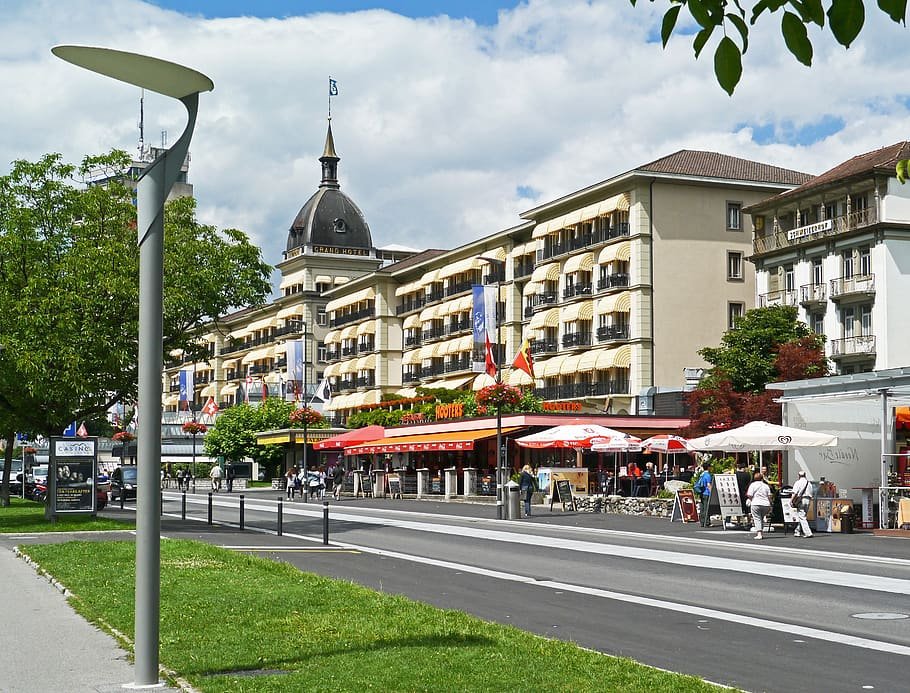
Best Hotels in Interlaken | From Budget to Luxury
Do you know which are the best hotels in Interlaken?
I was mesmerised the first time I visited Interlaken. I had seen pictures of the turquoise lakes, the snow-capped mountains, and the charming Swiss architecture, but nothing could prepare me for the real thing.
From the minute I stepped off the train at Interlaken Ost, I could feel the crisp Alpine air and the buzz of anticipation in the air. This wasn’t an additional stop on the map! It was a portal to some of the most beautiful places on Earth.
However, as beautiful as Interlaken is, I soon discovered that one key factor in your experience is where you stay. I remember booking a budget hotel the first time I visited, reasoning that I wouldn’t be in my room much.
But after days filled with hiking, paragliding, and boat tours, I wanted a cozy, welcoming space to chill. On subsequent trips, I experimented with various Interlaken hotels, from luxury resorts to lakeside stays, and every one of them coloured my experience differently.
Whether you’re looking for adventure, romance, or a relaxing escape, the hotel you pick in Interlaken is crucial. So below, you will find my ultimate guide to the best hotels in Interlaken, based on firsthand experience, authentic guest reviews, and local insights.
From luxury five-star retreats to budget accommodation like Hotel Interlaken and other charming options, I’ll help you find the perfect Interlaken accommodation so you can wake up to magnificent mountain scenery and make the most of your Interlaken trip.
 Victoria-Jungfrau Grand Hotel & Spa (Luxury Hotels in Interlaken)
Website: victoriajungfrau.ch
Location: Höheweg 41, 3800 Interlaken, Switzerland
I was suddenly transported to a different world in my first step inside the Victoria-Jungfrau Grand Hotel & Spa, a world of elegance that probably hadn’t changed much from the day the place opened with grand chandeliers, luxurious furniture and stunning views of the Jungfrau mountain. This is not only a hotel; it’s an experience and if you want the definition of a luxury stay in Interlaken, this is where you’ll want to be.
Overview & Location
This 5-star gem is situated right in downtown Interlaken and has been hosting daytime visitors for over 150 years. It sits between Lake Thun and Lake Brienz and is surrounded by sweeping views of the Swiss Alps. Among the most iconic hotels in Interlaken, you step outside and you’re in the thick of it all, restaurants, shops, and even the train station, which offers easy access to the Jungfraujoch.
But once you get inside the Victoria-Jungfrau, you might not want to leave.
Rooms & Suites – Pure Elegance
From luxurious rooms to suites, the hotel caters to everyone who wants to experience a royally splendid stay. Look for plush bedding, elegant furniture, and oversized windows that offer the ideal mountain frame. For the best experience, book a Jungfrau-facing suite the morning views of the snow-covered peaks are nothing less than magical.
Personal Tip: Notify the hotel in advance if you’re celebrating something special. Some include little extras such as chocolates or champagne in your room!
Spa Nescens – A Wellness Paradise
Another great highlight of this hotel is its ultra-luxury spa. I had an entire afternoon at the Spa Nescens, and let me tell you it was heavenly. The heated infinity pool faces the mountains, and the spa has steam baths, saunas, and signature Swiss wellness treatments.
This is where you come to relax and recharge. After a tiring day exploring, schedule a deep-tissue massage, and you’ll be as good as new.
Personal Tip: The spa is very popular, so schedule your treatments ahead of time if you do not want to miss out!
Dining – A Culinary Experience
This hotel is deadly serious about dining, with several fine dining options:
La Terrasse Brasserie - Posh French fare with sweeping mountain views.
Ristorante Sapori - Great for those who love authentic Italian flavours, especially pasta.
Victoria Bar - A quaint lounge with Swiss wines and cocktails.
I still have dreams about this place’s breakfast buffet the freshly baked croissants, the Swiss cheeses, the locally sourced honey that tastes like nothing I’ve encountered elsewhere.
Insider Tip: The chocolate soufflé at La Terrasse is out of this world.
Activities & Attractions in the Area
- When you stay here, you’re just minutes away from some of Interlaken’s top activities:
- Jungfraujoch – Top of Europe (Take a scenic train ride to the glaciers!)
- Oh, Paraglide Over Interlaken (Launch straight from the hotel’s backyard!)
- Boat Tours on Lake Thun & Lake Brienz
Personal Tip: Our hotel concierge was incredible, and this can help with getting recommendations tailored for you on things you should do while you are in town!
Is It Worth It?
Yes, without a doubt. The Victoria-Jungfrau Grand Hotel & Spa doesn't come cheap, but this is where you want to stay if you want a once-in-a-lifetime luxury experience in Switzerland. Between the stunning vistas and the unparalleled spa and dining experience, it’s an unforgettable retreat in the heart of the Swiss Alps.
Who Should Stay Here?
- These categories include partners in search of romantic getaway couples & honeymooners.
- For luxury travellers seeking the best of the best
- World-class spa lovers and wellness seekers
Is This Your Perfect Stay?
Victoria-Jungfrau Grand Hotel & Spa in Interlaken is a dream destination for those looking for lawless luxury, bold views, and exceptional hospitality.
 Hotel Interlaken (Best Mid-Range Hotels in Interlaken)
Website: hotelinterlaken.ch
Location: Höheweg 74, 3800 Interlaken, Switzerland
On one of my visits to Interlaken, I wanted something comfortable but affordable, a hotel that had a bit of character but wasn’t too pricey. That’s when I discovered Hotel Interlaken, and truthfully, it was one of my best hotels in Switzerland.
Located in a historic building near Charles Bridge, this 4-star beauty is the perfect mix of history, comfort, and location, making it a good mid-range choice for travelers looking for quality without the luxury price.
A Hotel with History & Charm
One of the oldest hotels in Switzerland, Hotel Interlaken, can be traced to 1323, yes, it’s more than 700 years old! But don’t be fooled by the history; the hotel is modern, chic, and well-kept. The old-fashioned charm of the Swiss is still in place, with contemporary amenities that make each stay even better.
Only a 5-minute walk from the Interlaken Ost train station, this is an ideal hotel for sightseeing the town and visiting Jungfraujoch, lake Brien, and Harder Kulm.
Personal tip: If you’re a history buff, ask the staff about the hotel’s previous guests famous poets and musicians!
Comfortable & Stylish Rooms
Hotel Interlaken is modern, cosy, and immaculate, and the rooms offer magnificent views of either the mountains or the gardens. Rooms options are Standard, Superior, and Deluxe based on your budget.
I upgraded to a Superior Double Room, spacious, bright, and with a super comfy bed just what I needed after long days exploring so much of the city.
Pro-Tip: Ask for a room that faces the garden and you will enjoy the quietest and most beautiful stay!
Beautiful Japanese Garden & Outdoor Space
This particular hotel has an adjacent Japanese garden that is so beautiful, it elevates the experience. It’s a low-key, calming space to have a cup of coffee in the morning or have a break between all the sightseeing.
Insider Tip: Get a drink in the garden in the evening it’s a hidden oasis in town!
Amazing Breakfast & Dining Options
I was excited about the great Swiss breakfast buffet here every morning. It had fresh bread, local cheeses, eggs, and fresh fruit a great way to start the day.
The hotel has its restaurant and bar for dinner, but if you want to try some local Swiss dishes, there are many restaurants within walking distance.
Personal Attempt: If you want something local, go for the Swiss Rösti (crispy potato dish) at a local restaurant!
Great Value for Money
For a centrally-located 4-star hotel in Interlaken, Hotel Interlaken is great value. It’s not as pricey as luxury hotels, but you still receive top-class comfort, excellent service, and a prime location.
Who Should Stay Here?
- Couples & solo travellers seeking quality & comfort
- Families looking for generous, well-designed rooms
- For travellers looking for a central location but not luxury rates
Where Should You Stay?
If, however, you’re in search of a mid-range hotel with history, comfort, and a great location, Hotel Interlaken is one of the best options in town.
 Hotel Beausite (Best Budget-Friendly Interlaken Hotels)
Website: beausite.ch
Location: Seestrasse 16, 3800 Interlaken/Unterseen, Switzerland
During one of my visits to Interlaken, I wanted to find an affordable, budget-friendly Interlaken hotels that could still provide comfort, beautiful views, and a genuine Swiss experience. That’s when I stumbled upon Hotel Beausite, a delightful, family-run hotel that was a home away from home. This is one of the best places to stay in Interlaken if you want affordable accommodation without compromising on quality.
Cozy Swiss Charm with a Great Location
Hotel Beausite: Set in a quiet, picturesque area, a 10-minute walk from Interlaken West train station. While it’s not right in the town centre, it is close to restaurants, shops, and activities and has the added benefit of being away from crowds.
The architecture is typical of chalets in Switzerland but has a warm, inviting feel, and as soon as I arrived I was greeted with a real sense of hospitality from the owners. You know this is a family-run hotel, a place where they genuinely want you to feel at home.”
Personal tip: Request a mountain-facing room the views of the Bernese Alps in the morning are stunning!
Comfortable Rooms with a Warm Ambience
Rooms at Hotel Beausite are basic but homey, with wooden furniture, comfortable beds, and big windows that fill the rooms with natural light. They are features from economical single rooms to family suites, so it is perfect for both lone travellers and families.
One of the best things? You get Swiss chocolate on arrival! It’s a small touch, but it made my stay feel slightly elevated.
Tip for the personal: Nice and quiet, the garden-view rooms offer a lovely, peaceful environment.
Free Breakfast & Swiss Hospitality
Personally, one of the things I love most about Hotel Beausite is the inclusion of Swiss breakfast. Each morning, I feasted on a spread of fresh-baked bread, local cheeses, yoghurt, fruit, and homemade jams great fuel before heading out to explore.
There is also an on-site restaurant that serves tasty Swiss cuisine in the evening.
Personal Tip: For those who are on a budget, make sure to take advantage of the free afternoon coffee and cake served in the lounge!
Close to Top Attractions & Activities
That means when you stay at Hotel Beausite you’re only a hop from:
- Harder Kulm - Ride the funicular to this vantage point for sweeping views.
- Lake Thun & Lake Brienz - Take a cruise or walk along the lakeside.
- Schynige Platte - Gorgeous hiking area with quintessential Swiss Alps views.
Staff will also happily assist with tour bookings and offer local recommendations on things to do.
Helpful Tip: Most hotels give out a free public transport pass! Make sure to ask the front desk for one to transfer around Interlaken at no cost!
Why It’s the Best Budget Stay
Hotel Beausite is one of the best-value places to stay in Interlaken. It’s got fair prices, Swiss charm, and warm hospitality without being a rubber-stamped basic budget hotel.
Who Should Stay Here?
- Budget-conscious travelers still seeking comfort.
- Backpackers & solo travellers looking for a homely vibe
- Families & couples seeking a peaceful, homey stay
Should You Stay Here?
For a cheap hotel in cozy Interlaken with great service and views, check out Hotel Beausite.
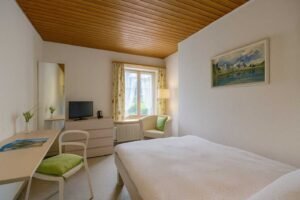 Neuhaus Golf- & Strandhotel (Best Lakeside Hotels in Interlaken)
Website: neuhaus-interlaken.ch
Location: Seestrasse 121, 3800 Unterseen, Switzerland
During one of my formative trips to Interlaken, I was looking to retreat from the lake-facing hustle of activities in town, and wanted to spend the night somewhere more serene, somewhere I could wake up to the sights of a lake, rather than the sounds of the city. That’s when I found Neuhaus Golf- & Strandhotel, and I’ll tell you now, it was one of the most relaxing stays I’ve ever had anywhere in Switzerland.
If you seek a peaceful lakeside escape amid greenery, water, and fresh Alpine air, this is it.
A Hidden Gem on Lake Thun
In contrast to most hotels in Interlaken that are central to the town, the centre of town, Neuhaus Golf- & Strandhotel is directly on the shores of Lake Thun about 10 minutes from Interlaken. All around are gorgeous lake and mountain views in what feels like a private retreat.
As soon as I got there, I knew I made the right choice because the gentle sound of waves, the mountain air, and the quiet atmosphere were home to me.
Personal Tip: Because it’s somewhat outside our downtown, the hotel provides free parking if you’re driving. There’s also a boat and bus stop nearby that makes it easy to get around if you don’t have a car.
Cozy, Scenic Rooms
The rooms are basic but lovely, with wood accents and large windows overlooking the lake or mountains. Upon waking up, the two of us can then take a step outside onto a private balcony with a lake view.
Rooms are large and comfortable, and I enjoyed how quiet and peaceful it felt versus city hotels.
Your Sub Tip: Book a room facing the lake you’ll thank yourself later, if only because of the view!
Outdoor Activities & Relaxation
The best thing about Neuhaus is that you don’t even have to step outside of the hotel to enjoy a good time.
- Private lakeside beach - perfect for swimming & sunbathing
- Kayaking & paddleboarding - hire from the hotel & discover Lake Thun
- Scenic hiking trails - trails begin right outside the hotel.
Golf course - gets you up if you want to combine a round of golf with mountain scenery.
I kayaked on the lake in the mornings and relaxed in the afternoons on the hotel’s private beach It was like a secret Swiss paradise.
Personal Tip: Rent a stand-up paddleboard at dawn, when the lake is calm, it’s a one-of-a-kind experience!
Lakeside Dining with a View
For dining, the hotel’s restaurant and terrace are located directly on the lake, providing stunning views as you eat. I had dinner here at sunset and the pink and orange hues reflected on the water made for one of my most scenic meals ever.
Personal tip: Don’t miss the fresh fish from Lake Thun - it’s local and tasty!
A Peaceful Escape at a Great Price
In Interlaken, a comparatively cheap option for a lakeside hotel is Neuhaus Golf- & Strandhotel, given its location and private beach access. Best if: You want a tranquil, nature-filled experience while avoiding the price tag of a 5-star resort.
Who Should Stay Here?
- Those who want to be near a lake as nature lovers
- Guiding Couples & honeymooners seeking a romantic getaway
- Those who like to stay outside the city, peacefully
- This Is Your Ideal Lakeside Getaway, Right?
For a slower-paced, more coral escape on Lake Thun, Neuhaus Golf- & Strandhotel gets the nod. It’s picturesque, tranquil, and full of outdoor recreation a sublime place to get back to nature.
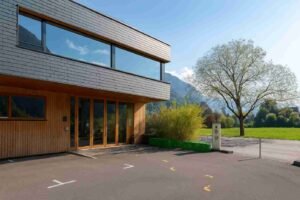 Backpackers Villa Sonnenhof (Best for Backpackers)
Website: villa.ch
Location: Alpenstrasse 16, 3800 Interlaken, Switzerland
For one of my solo trips to Interlaken, I was looking to travel as cheaply as possible while still maintaining comfort. That’s when I found Backpackers Villa Sonnenhof a clean, comfortable, and well-run hostel that felt more like a welcoming home than a backpacker hangout. Best Hotels in Interlaken If You’re Visiting Solo Travel, On a Budget, or Want to Meet Members of the Travel Tribe
A Budget Stay with a Luxury Feel
Backpackers Villa Sonnenhof, however, doesn’t have the cramped, chaotic feel of many hostels. The rooms are bright, the building is modern, clean, and spacious.
It’s situated right in the middle of Interlaken, within walking distance of both Interlaken Ost and Interlaken West train stations, so it’s super easy to get to locations surrounding it. Also, it provides free public transport passes, a big plus for budget-friendly visitors.
Personal Tip: Request a room facing the mountain no amount of money can buy you waking up to the Swiss Alps!
Comfortable Rooms & Great Amenities
With a combination of shared dorms and private rooms, Backpackers Villa has a bed and a lot of space (a rarity for a hostel!) for everyone, all with super comfy beds. Traveling solo or in a group, you’ll find an option that is right for you.
What do I love the most? Free coffee & tea, free WiFi, and even free access to a swimming pool and mini-golf course for every guest!
Personal Tip: If you want more privacy, book a private double room, it’s still cheap but makes you feel like you’re in a small hotel.”
Free Breakfast & Kitchen Access
So what’s one of the coolest things about this hostel? They have FREE breakfast every single morning! They serve fresh bread with Swiss cheese, fruit, and coffee a perfect way to fuel up before a day of adventure.
There’s also a fully equipped kitchen, so you can cook your meals and save money if you want.
Tip: Buy groceries from a local Coop / Migros supermarket and make dinner the Swiss way!
Perfect for Adventure Seekers
From hiking to skiing, Interlaken is the adventure capital of Switzerland, so what better base for adventure lovers than this hostel? Whether paragliding, canyoning, or hiking, the hostel staff can assist in booking the activities at discounted rates.
Personal Tip: If you’re new to Interlaken, join a hostel group hike it’s a great way to meet other travellers!
Why It’s the Best Budget Hotel in Interlaken
Free breakfast, great amenities, and the best location for a hostel price. Backpackers Villa Sonnenhof is the place to be if you are traveling solo, traveling with friends, or want a cheap stay.
Who Should Stay Here?
- Solo travellers want to meet people.
- Backpackers on a budget
- Budget-minded adventurers looking for an economical base
Is This Hostel Right for You?
Backpackers Villa Sonnenhof has to be the best hostel in Interlaken for budget accommodations with fantastic perks and a friendly vibe.
 Lindner Grand Hotel Beau Rivage (Best Classic Luxury Hotel in Interlaken)
Website: https://www.grandbeaurivage.ch/
Address: Höheweg 211, 3800 Interlaken, Switzerland
The first time I entered Lindner Grand Hotel Beau Rivage, I got the impression of entering a classic Swiss fairytale. It was winter, and fine snow was covering the hotel’s majestic white front, making it look even more elegant and iconic. As I opened the doors to the lobby, the warm light of chandeliers, the murmur of guests in the lounge,e and the faint whiff of Swiss hot chocolate greeted me indoors.
I knew then and there - this was not just any luxury hotel. It was a scrap of Swiss history.
A Timeless Swiss Gem
One of the most iconic hotels in Interlaken, Lindner Grand Hotel Beau Rivage is only a 5-minute walk from Interlaken Ost train station. Renowned for its old-world elegance, majestic architecture, and delightful views of the Aare River and Jungfrau mountain, this 5-star hotel.
It has a soul, unlike modern luxury hotels that can be too polished and impersonal; Lindner Beau Rivage has a certain character. Its rich history is palpable in every detail - from the graceful chandeliers to the old-fashioned Swiss woodwork.
Tip for Travelers: Request a river-facing room on a higher floor; the views of the Aare River with the Alps in the background are magical.
Rooms: Classic Elegance with a View
I stayed in a Deluxe Room with a balcony, and I literally could have stayed out there with coffee all day watching the river go by. The rooms are large, with traditional Swiss-style wooden furniture, soft carpets, and oversized windows flooding the space with natural light.
What do I love most? The little touches
- A welcome note and Swiss chocolates on the bed
- Luxurious bathrobes that felt like I was at a spa
- A pillow menu (yep, you can select what kind of pillow you’d like!)
Personal Tip: If tell them ahead of time - they often upgrade guests or leave surprise gifts in the room!
Dining: Swiss Delights & Fine Dining
One of the highlights of staying here is the on-site restaurant, L’Ambiance. It’s among the best in Interlaken and serves a range of Swiss, French, and international dishes.
I still dream about the cheese fondue I had here - creamy, rich, and paired with crisp, freshly baked bread. And breakfast? Now, let’s just say, they had a buffet of fresh pastries, Swiss cheeses, and local honey that we woke up to every day.
Personal Tip: If you’re travelling in winter, reserve a table by the window - dining as you watch the snow fall outside is magic.
Spa & Wellness: Pure Relaxation
If you’ve had a busy day actively exploring Interlaken, then unwinding at the spa is undoubtedly the best thing to do. The heated indoor pool was my personal favourite, particularly because it has gigantic glass windows overlooking the mountains. There’s also a sauna, steam bath, and fitness centre, but really? I was too mindful floating in that pool to go to the gym!
Personal Tip: After a day of hiking, have a massage, the Swiss Alpine Aroma Massage is just amazing.
Location: Perfect for Exploring Interlaken
The biggest advantage of staying at Lindner Grand Hotel Beau Rivage is its prime location:
- 5 min walk from Interlaken Ost train station
- Near the famous Harder Kulm funicular
- Access to Lauterbrunnen, Grindelwald, and Jungfraujoch
Whether you want to cruise Lake Brienz, paraglide over Interlaken, or catch the train to Jungfraujoch (Top of Europe), this hotel sets you up for it.
Pros & Cons
Pros:
- Old-world elegance is ideal for fans of classic Swiss charm
- Brilliant views over the river and mountains
- Best breakfast & restaurant on-site
- Swimming pool & spa
- Ideal base for exploring Interlaken
Cons:
- Rooms might appear a little outdated to those who prefer contemporary designs.
- Depending on when you book, it can get expensive (hello, peak seasons)
- Not much parking so if you’re driving book a spot in advance
Is Lindner Grand Hotel Beau Rivage Worth It?
If you appreciate a classic European luxury experience with stunning views, then yes, this is one of the top hotels in Interlaken.
Would I stay here again? Absolutely. Whether you're looking for a romantic getaway, solo retreat, or casual luxury escape, Lindner Grand Hotel Beau Rivage is a classic that meets all your needs.
Where Should You Stay?
Interlaken is one of the most beautiful places to visit in Switzerland, and staying at the right location can make your trip more memorable. For luxury, adventure, or a cheap getaway, there’s a hotel to match your travel style.
Here’s a quick summary of the best hotels in Interlaken depending on the type of experience you’re after:
Luxury & Spa Retreat: Victoria-Jungfrau Grand Hotel & Spa – Best for 5-star luxe, spectacular mountain vistas and a top-notch spa.
Best Mid-Range Stay: Hotel Interlaken – Ideal balance of comfort, history, and location without luxury prices.
Where to Stay on a Budget: Hotel Beausite – A lovely little hotel with genuine Swiss hospitality at a fair price.
Lakeside Escape: Neuhaus Golf- & Strandhotel For visitors who enjoy tranquil views of the lake and activities outdoors.
Best Hostel for Backpackers: Backpackers Villa Sonnenhof is Budget-friendly, clean, and communal, the best budget place to stay for solo travelers and adventure seekers.
My Recommendation:
Hopefully, you've now found the best hotels in Interlaken! If it’s your first time in Interlaken, I would recommend staying at Hotel Interlake as it is the best combination of comfort, location, and price. If you’re here for a honeymoon or special occasion, Victoria-Jungfrau Grand Hotel & Spa is worth the splurge!
What are your favourite hotels to stay at Interlaken?
Now it’s your turn. Have you visited any of these hotels? Or does another come to mind as your favourite? Let us know your thoughts in the comments below!
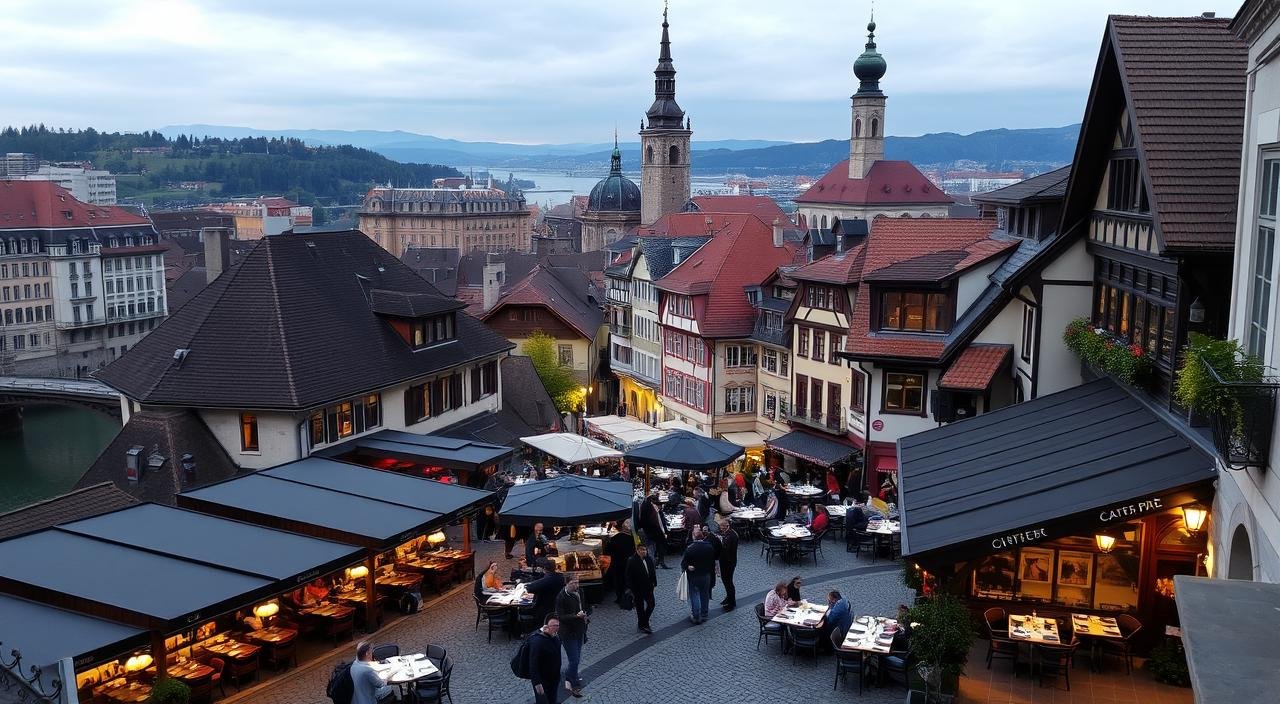
Best Restaurants in Bern
Best Restaurants in Bern when I came to Bern, nothing was planned in terms of food. Walking in old town streets, I got tired of wandering around Clock Tower Zytglogge.
I felt that I should sit and enjoy something tasty, so I didn't take a Google route, I asked an old lady, Where do you eat?
She smiled and said, Go to Metzgerstubli. I've been having meals here for many years. It's home food.
Then I realized the advice of locals was never neglected. I went to Metzgerstubli and felt at home. AHotsmoked Bern-style sausage and mashed onions in onion gravy warmed my heart. From there, I started learning about tBern's restaurant scene.
I always take a new restaurant whenever I am there. Some of the restaurants that feel cozy to dine in are the Kornhauskeller, its huge roof, and its old-world ambiance.
This guide is my genuine effort to tell you those stories and experiences. Whether you’re a wandering traveler or a local in quest of secrets, I’m going to take you around Bern’s best dining spots, with personal tips, practical advice, and of course, a few unforgettable food stories. So buckle up for a culinary tour of Switzerland's capital heart!
 Best Restaurants in Bern that You Cannot Miss: The Complete Guide
Fine Dining Restaurants:
From my own experiences, here is a guide to Bern’s finest restaurants that you absolutely cannot miss. I’ve also included useful details such as location and links to their websites to enable you to plan a hassle-free outing.
Kornhauskeller – Top Restaurant Choice for a Luxury Swiss Dinner
Location: Kornhausplatz 18, 3011 Bern
Website: www.kornhauskeller.ch
One of Bern’s most popular dining places, Kornhauskeller is housed in a magnificent cellar that is adorned with excellent frescoes. The elaborate decor is reason enough to dine here. I remember feeling spellbound when I arrived I felt like I was having dinner in a palatial ambience. The staff is polite, and their classic Bernese food is a treat to savor.
What to Have:
- Bernese Platter of local cured meat and cheese
- Home-made Rösti
- Sweets of season
Personal Tip: Book in advance, even during weekends. I would recommend visiting in the evening when the ambiance is at its magical high.
Schwellenmätteli Restaurants – Top Restaurant Choice for Riverside Dining
Location: Dalmaziquai 11, 3005 Bern
Website: www.schwellenmaetteli.ch
Dining over a lovely view of River Aare is something you can enjoy in style at Schwellenmätteli. The restaurant complex has different areas to dine in, such as a fine dining section and a riverside café that is easily accessible. I love visiting here during warmer months.
What to Have:
- Grilled fish of Biel Lake
- Creative vegan food
- Excellent wine collection
Personal Tip: Visit during a sunny day and sit on the balcony. It’s a great place to enjoy Bern’s lovely riverside view when you love having food.
Lötschberg – Top Restaurant Choice for Swiss Comfort Food
Location: Zeughausgasse 16, 3011 Bern
Website: www.loetschberg.ch
If you’re in the mood for a Swiss comfort food treat, you need to be at Lötschberg. I stumbled upon this restaurant during one of my first trips to Bern, and it stole my heart in a flash. The cozy interior and friendly staff set a homey ambiance that you feel comfortable in.
What to Try:
- Cheese Fondue (it’s their flagship dish!)
- Raclette platter
- Local sausages
Personal Tip: Do not miss fondue. Have it served with a crisp wine of the wine-growing region of Valais to enjoy a quintessentially Swiss meal.
Restaurant Harmonie – Top Choice for Swiss Comfort Food
Address: Hotelgasse 3, 3011 Bern
Website: https://www.harmoniebern.ch/
Restaurant Harmonie has served up Swiss food in a genuine manner since 1915. The old-world charm of the restaurant coupled with warm food makes it a regular haunt to hit up for Swiss comfort food. I adore visiting it during winter when their food warms you up inside out.
What to Order:
- Veal Zürcher Geschnetzeltes with Rösti
- Bernese Platter
- Seasonal soups
Personal Tip: The staff is highly knowledgeable when it comes to local wine. Ask their advice to pair it with your meal.
Einstein Café & bel étage – Top Choice for Breakfast Buffs and Coffee Connoisseurs
Address: Kramgasse 49, 3011 Bern
Website: www.einstein-cafe.ch
Dedicated to Albert Einstein, who lived in Bern during his productive phase, this is a great place to enjoy a warm breakfast or a quick coffee break. The ambiance is elegant yet easy to relax in, and their breakfast is to die for.
What to Order:
- Traditional Swiss breakfast platters
- Fresh coffee
- Home-made cakes
Personal Tip: The place is soon packed, especially during weekend mornings. Visit early to get a seat in front of the window to enjoy a nice view of the busy street.
Best Budget-Friendly Restaurants
Whereas Bern is eminent for its luxury, there is moreover a plenty of budget-friendly restaurants that provide amazing esteem for cash. I review my remain at Mille Sens, a cozy small café that serves a phenomenal combination of Swiss staples and modern nourishment at a cost that won’t harmed you. From a tasty rösti to a scrumptious vegetable serving of mixed greens, there is something to meet each require on the menu. One of the highlights is that a inviting nearby environment implies you feel you’re having supper at a buddy’s house, not in a restaurant.
The other amazing budget-friendly restaurant is Café des Amis, a brief walk up Gurten Slope. Here you can eat on a tasty dinner without overspending. From a fresh croissant in the mornings to pasta suppers in the evening, there are bounty of choices to select from that won’t burn a gap in your wallet. It’s a incredible put for visitors and local people to kick back and appreciate a dinner without squeezing pennies.
Street Food Eateries
One of my favorite parts of Bern’s food scene is its street food scene. Any day of the week, you can find food stalls selling everything from Swiss sausages to foreign treats. I’ve dined on my best meals just strolling around Bern’s markets. The Bundesplatz Market, for example, has food stalls selling freshly cooked sushi rolls, gourmet burgers, and Swiss-style skewers.
My personal experience of Bern's hot dog sold at one of the stalls around Zytglogge Tower is one that I will never forget. Made of local sausage served with freshly baked bread, it is a quick yet delicious introduction to Bern. In case you want to taste something different, you should not miss having a Swiss pretzel, a classic snack for streets. The crispy exterior and soft interior are to die for.
Best Family-Friendly Restaurants
In case you’re visiting Bern in the company of children, Bern boasts several family-friendly restaurants in which you can sit for a meal in comfort. One of my favorites is Restaurant Rosengarten. Situated high up in Bern, this family-friendly restaurant treats you to a view of Bern that is nothing short of dramatic, combined with a child-friendly menu. The large seating is spacious enough to accommodate small children in comfort.
For a more loose climate, you ought to feast at Vineria–Lo Stivale when you’re going to Bern in the company of children. The Italian restaurant serves up naturally cooked pizzas and pasta, in a cozy climate that is speedy to get to you. The eatery staff is moreover profoundly pleasing, making it a hassle-free supper time when you’re feasting in the company of children.
While eating in the company of children, select for restaurants that give sound however delicious food choices and diversion in the shape of movement sheets or play regions for children. Bern is not brief of such places, making it a incredible put to discover a eatery that is appropriate for your family.
Bern's Traditional Cuisine Restaurants
If there's one thing that's most representative of Swiss food, it's that comfort and tradition that each meal embodies. Living in Bern for a considerable time, I can vouch that Berners take Swiss traditional food close to their heart. You don't just eat it, you live it. I remember my first time having fondue in a small restaurant in Bern's Old Town. The gooey cheese dipped in crusty bread was an initiation to Swiss food in a way. If you’re in Bern, you need to dive into these classic foods.
Fondue: The Swiss Staple
I start with fondue, Switzerland's most typical nourishment in my see. It's not cheese; it's a ceremony of nourishment section. The handle of plunging a blob of bread in a vat of gooey cheese, savoring its smooth surface, and sharing it around among family or companions is something quintessentially Swiss. The Cheese Fondue that you discover in Bern is for the most part a blend of Gruyère and Emmental cheese, coming about in a smooth, marginally acrid flavor that is liberal however homey.
What to Do: If you’re a newcomer to fondue, I would prescribe you get it in Lötschberg, a eatery that’s eminent for its fondue.
Personal Tip: Keep the bread crispy and take it in small pieces to avoid it sliding into the pan—something I used to do in my first fondue time!
Rösti: The Swiss Pancake
Another, we've got Rösti, a pan-fry of fresh fricasseed potatoes that is a favorite of numerous of the local people. It's a fast, simple supper that is regularly taken for breakfast or served to go with meat. I keep in mind having Rösti served up nearby a side of wiener in a little eatery in Rosengarten. The potatoes are fair fresh sufficient on the exterior and cushy in the center, and the wiener is fair a superb combination.
What to Try: Have their Rösti served up alongside Berner-style sausages at Metzgerstübli. The combination is heavenly.
Personal Tip: Top it up with a fried egg for a little decadence it’s a total game-changer!
Berner Platte: The Swiss Hearty Platter
While in Bern, you just have to be sure to try Berner Platte a classic Swiss platter that’s tasty, hearty, and just great for a person of large appetites. Topped typically with sausages, pork, sauerkraut, and potatoes, it’s a great reflection of Bern’s agrarian heritage.
What to Try: I tried Berner Platte for the first time at Kornhauskeller. The meat was tender, and the sauerkraut was just right, adding a great tang that balances beautifully with the richness of the meat.
Personal Tip: This is a sharing platter take your family or friends with you to get the most out of this decadent meal.

Best Vegan & Vegetarian restaurants: Bern's Plant-Based Eating
As intrigued in plant-based eating develops, Bern was speedy to get in on the activity, advertising a wide run of vegetarian and veggie lover nourishment all through Bern. From veggie lover stews to unused, plant-based substitutes, there's bounty to enjoy.
I was blessed to get a taste of Bern's veggie lover nourishment scene, and it was a treat to discover such a huge number of awesome places that served up scrumptious and homey plant-based suppers. I was unused to having eaten plant-based dinners in Switzerland, so I didn't know what to anticipate until I was served a jaw-dropping dinner at Tibits, a veggie lover buffet that changed my discernment of devouring plant-based.
Tibits Bern Gurtengasse: A Vegan Buffet Paradise
I venerate Tibits. It's a buffet eatery that serves up a assortment of veggie lover and vegan dinners, all utilizing crisply sourced, convenient fixings. As I arrived, I was welcomed with a revolt of color and a drift of cooked vegetables, grains, and vegetables that were outlandish to stand up to. I stacked my plate up with simmered sweet potato, colorful quinoa servings of mixed greens, and a hot chickpea stew.
What to Eat: Their vegetarian chocolate mousse is a must-order. It's wanton, smooth, and fair the treat to conclude a dinner on a sweet note.
Personal Tip: Don't overdo it on the initial plate load-up take it easy, start small, and return for more if you’re not yet satiated. There are just too many options to choose from, you’ll want to taste everything!
Dabbavelo: A Vegan Foodie Street Food
For something a little different, I highly recommend Dabbavelo a vegan Indian food stall. It’s a new stall that brings bold Indian spices to Bern’s streets. I came across Dabbavelo one night when I was wandering around Bundesplatz, and it soon was one of my regular spots to get a quick yet satisfying vegan meal.
What to Try: The vegan wraps and curries burst of flavor, with just enough heat. I just love their chana masala wrap it’s a meal in a wrapper that’s just great to take on the run.
Personal Tip: Keep up to date with Dabbavelo’s social media to know where to find it next time. Because it’s a food truck, it’s always in a different place.
Dessert & Cafés: Sweet in Bern
While I love a great meal, I also have a wonderful fondness for Swiss desserts. There’s something magical in Swiss bakeries’ approach to their sweets and pastry. From decadent chocolate cakes to delicate pastries, Bern’s desserts are just the way to end a meal or to enjoy on their own.
While in Bern, I came across a wonderful range of dessert spots that soon enough became my favorites. Each is different, yet each is certain to sate your sweet tooth.
Gelateria di Berna: The Gelato Experience
When I think of dessert in Bern, Gelateria di Berna is always my point of origin. This gelateria serves up the creamiest artisanal gelato I’ve ever found. The offerings are varied, always freshly changed up to meet each season.
What to Try: The pistachio gelato here is to die for. It’s nutty, it’s creamy, and it’s just the right sweetness. If you’re up to it, their saffron and rosewater is something that’s uniquely Swiss and is worth a try.
Personal Tip: Enjoy Gelateria di Berna after a walk in the Rosengarten the perfect way to enjoy your gelato over a view of the city.
Confiserie Tschirren: Chocolate Pastry Paradise
Switzerland is celebrated for chocolate, and that’s where I went to get my chocolate settle. This little chocolate shop in Bern is domestic to a collection of handcrafted chocolates and cakes that you fair can’t resist.
What to Attempt: Their handcrafted truffles are magnificent, and their Swiss chocolate bars are incredible to take domestic as gifts.
Personal Tip: Take a few chocolates home from Confiserie Tschirren to share with your friends. They’re always a hit!
International Restaurants: Global Eating in Bern
While Swiss food is Bern’s culinary soul, the city also boasts a collection of international foods to choose from. From Italian to Asian-fusion foods, Bern’s diverse restaurants give globetrotters and locals a chance to enjoy foods that supplement the classic offerings.
I’ve always been a foodie of international food, and Bern is never short of options for those occasions when you just want something different. Whether you’re in the mood for a classic Italian pizza or a spicy Thai curry, you’re in luck.
Casa Novo: Swiss Meets Mediterranean in Style
Casa Novo is one of my favorites when I am in the mood to savor Swiss-Mediterranean food. With a view of River Aare, it has wonderful food to be paired with wonderful scenery. The restaurant is cozy without compromising sophistication, and it also has great services.
What to Try: The seafood risotto here is one of my favorites. Fresh, delicious, and cooked to perfection, it’s one of my favorites when I’m here.
Personal Tip: Sit river side there’s something to be said for having dinner to the backdrop of moving water.
Little Thai: Real Thai Food in Bern
Little Thai is a treasure for anyone in Bern looking for a taste of Thailand. The moment you walk in, you’re in Thailand surrounded by lemongrass, coconut milk, and spices in the air.
What to Try: One of the better green curries I’ve tried outside Thailand is here. Creamy, rich, and just spiced to perfection.
Personal Tip: The portions here are large, order a few to get a true taste of Thai food.
Bern Old Town (UNESCO World Heritage Site)
Bern’s Old Town is a treasure house of history that brings you to a distinctive time, and my feasting here is something that I won’t before long disregard. Strolling around Bern’s cobble lanes, I felt like I was in a storybook when I saw houses of long time past times.
The Bern Old Town, a UNESCO World Legacy location, is domestic to a few of Bern’s most celebrated eateries. Here you get to appreciate a extraordinary marriage of old-world charm and modern feasting experiences.
I keep in mind my to begin with supper in Bern's Ancient Town, fair over from Bern's celebrated clock tower of Zytglogge. I feasted in a little, cozy eatery in which I was able to sit and observe the world walk by. The climate was warm and inviting, with local people and sightseers welcoming one another as they passed.
The restaurant food was a reflection of the conventions of the locale, utilizing neighborhood, new fixings to cook healthy Swiss food.
Best Restaurants in Bern Old Town:
Kornhauskeller
This is a wonderful restaurant that is set in a wonderful old building called Kornhaus. The vaulted roofs and wonderful interior give a feel that you are having dinner in a palace. The food is a fusion of Swiss and Mediterranean influences.
If you find yourself in the Old Town, you definitely won't want to miss it.
What to Try: The Swiss classic foods here are excellent, and I would highly suggest that you order classic Berner Platte.
Restaurant Löwen
Set in a more quiet section of the Old Town, Löwen is a restaurant that serves Swiss comfort food in combination with international treats. The rustic yet sophisticated ambiance is wonderful for a high-standard yet easy meal.
What to Try: Their fondue is one of Bern's best! Have it paired with a glass of Swiss wine for a complete treat?
Personal Tip: Eating in the Old Town is a combination of magnificence and legacy, so take time to drench in the climate. The entirety put is walkable, so I would recommend investing a small time strolling around the roads previously or after you've eaten.
River Aare Side Restaurants
The most pure of Bern's restaurant scenes is on Stream Aare's side. I was able to eat in a riverside eatery on a sunny day, and it was brilliant to observe Waterway Aare's straightforward waters stream in the heart of Bern's city. The Waterway Aare is a brilliant background to a unwinding dinner, much obliged to its delicately moving streams and romantic-looking bridges.
Best River Aare Restaurants:
Restaurant Rosengarten
Located a short walk up from the river, the restaurant boasts a wonderful view of River Aare and Old Town. A restaurant is a wonderful place to sit over a meal in spacious scenic surroundings. The restaurant is a perfect place for one to get a break from Bern's busy ambiance, the restaurant is a peaceful place to dine in nature's settings.
What to Order: Their season salads are crisp and light, and their schnitzel is necessary.
Felsenau Restaurant
Felsenau is a wonderful family-run restaurant over the riverbank, providing Swiss and Mediterranean specialties. I was able to dine here for the cozy ambiance of the restaurant and the wonderful river view. The seating outdoors is just wonderful during warmer periods of the year.
What to Order: The fish that is grilled is heavenly, and their white wine is a wonderful pairing to the meal.
Personal Tip: If you’re having dinner here, it's a wonderful idea to get there just a little earlier than sunset to watch the golden color of the river. The view is just wonderful.
Hidden Gems or Secret Spots in Bern
One of my favorite things about Bern is that it also tends to surprise you with gems that you never would have found otherwise. These are not places that receive a great marketing push but are discovered only by word of mouth, or in my case, just wandering around Bern to get to know it. I've stumbled across a few of my favorites over time that added to my stay in Bern.
Best Hidden Gem Restaurants:
The little diamond in a calm corner of Bern is a local's mystery that is more associated to having supper at a house. One of Bern’s better-kept culinary insider facts, it serves up true Swiss nourishment in a cozy, insinuate air. I was invited in amid my remain in Bern in a warmth that was more associated to having supper at someone's house.
What to Try: Have their Bern-style sausages, expertly spiced up and served up with a side of creamy mashed potatoes.
Café des Pyrénées
On a small alleyway just close to Federal Palace is a small coffee house that serves up a cozy, relaxing ambiance in which to sip on homemade pastry and coffee. I love to drop in here to take a quick rest when I’m wandering around Bern, and their hot chocolate is one of the best I’ve ever tried.
What to Try: Freshly baked croissants that work beautifully with their excellent coffee.
Personal Tip: The key to discovering these hidden gems is to take time to walk around Bern’s lesser-seen streets, such as Bern's quiet streets of Old Town. Most of these places will surprise you with their charm and genuine ambiance.
These hidden gems not only give you delicious food but also allow you to feel that you’re tasting Bern in a more natural, less touristic way. So when you’re in Bern, do take a walk a little unconventional and discover these gems for yourselves. Be it a hidden river-front café or a cozy family restaurant in Old Town, these are the gems that set Bern aside.
Personal Recommendations
While I feast out, I appreciate choosing nourishments that not fair relate to nearby traditions, but too deliver something interesting in return. Here’s a preview of what I’ve found to be my favorites and what I feel you ought to order:
What to Order:
For Swiss Food: The Fondue (and more accurately the Cheese Fondue) is a must-order. I would arrange it at Lötschberg where it’s served up with flawlessly dried up breads and firm spuds. It’s wanton, wholesome, and fair idealize for a cold meal.
For a Light Meal: If you require something light however top notch, arrange the Swiss Rösti at Kornhauskeller. It’s a awesome feast to savor on a sunny day.
For Desserts: Gelateria di Berna serves incredible ice creams, but my individual favorite is their pistachio gelato. It’s smooth, cool, and genuine.
Seating Choices to Consider:
Kornhauskeller: If you’re in the temperament to be modern, seating in the center of the eatery beneath the vaulted ceiling is something you won’t before long disregard. Be that as it may, for a more hint feel, side booths following to the windows work fair great.
Restaurant Rosengarten: Sit on the overhang if you’re willing to appreciate a see of Bern’s Ancient Town in all its radiance. It’s incredible for supper when you can observe the see of the Aare Stream when the sun is set.
What to Order at Specific Times:
Lunch: If you discover yourself in Bern amid lunchtime, you can appreciate fast however delightful Swiss consolation food at Metzgerstübli, or their Berner Platter (Swiss platter of ancient) never fails.
Dinner: Casa Novo is awesome for supper. Cozy to start with, and advertising season-oriented suppers that vary each time depending on anything is in season, it's a extraordinary put to treat yourself to something modern each time.
Dishes in Season: Most eateries, such as Kornhauskeller, offer specials amid a specific time of year, such as amusement meat amid the harvest time season. If you discover yourself in Bern amid the harvest time season, be beyond any doubt to treat yourself to these neighborhood specialties.
Tips and Advice:
Reservation Tip: Continuously save, indeed at such a active put as Kornhauskeller and Metzgerstübli, amid the end of the week or occasion season. It's a little city but tends to get packed.
Time of Day: Early nights (around 6 PM) are incredible to visit Eatery Rosengarten when you can observe the nightfall amid dinner.
By keeping these individual tips in intellect, you can superior appreciate your mealtime excursion and appreciate indeed more time in Bern. Each eatery has its charm, and with a specific dish and vibe, you’re bound to appreciate a awesome time.
Travel Direct to Bern (One-Day Visit)
For a one-day remain in Bern, get the most out of a mealtime trip by going to the best places to feast. Begin your day at Confiserie Tschirren with a tasty Swiss baked good and a flawlessly brewed container of coffee. Feast amid lunchtime at Eatery Rosengarten, where you can treat yourself to a Swiss dinner to pass on for with extraordinary sees of the city. In the evenings, cool off at artisanal Gelateria di Berna, a Bern favorite.
Traveling with children? Lötschberg is a awesome family-friendly scene to appreciate Swiss consolation nourishment in the frame of fondue and raclette. Or, Altes Tramdepot close Bear Stop is a cozy put to feast in a low-key environment with a shifted run of nourishment and house-brewed brew. Feast impractically nearby Waterway Aare for a calm night.
End your night encompassed by neighborhood climate and devouring on Bern's culinary delights there's something for everyone!
Sustainability and Locally Sourced Ingredients in Bern’s Restaurant Scene
One of Bern's stand-out highlights is conceivably the drift towards maintainability and utilizing nearby fixings in Bern's restaurants. A few of Bern's eateries pride themselves on utilizing crisply sourced, convenient create from ranches close Bern and utilizing naturally inviting methods.
Kornhauskeller and Rosengarten are fair two of the eateries that pride themselves on their menus that pride themselves on neighborhood specialties, numerous of which utilize natural and morally sourced produce.
From my individual encounter, I review that Casa Novo was eminent for their utilize of fish that is convenient and neighborhood create. The staff indeed told stories of their participation with little, family-run ranches in Bern's fringe. I moreover adore Tibits, not fair for their vegetarian choices, but too for their endeavors in checking nourishment waste.
The farm-to-table strategy in Bern is more than a slant it's a way of life that permits a more seriously association between supporters and nature. This implies that each supper tastes veritable and wholesome.
Tips for Eating in Bern Restaurants
Make a Booking: The more well known eateries get totally booked up, particularly amid the end of the week and occasion season.
Try Local Specials: Be certain to arrange Berner Platte and Zibelechueche (onion pie).
Request Water: Swiss tap water is great, and most eateries would be more than cheerful to give it to you.
Seasonal Menus: Regular specials can be found in a few of Bern's eateries, so be beyond any doubt to check out these unused offerings.
Final Thoughts: Savoring Bern’s Culinary Delights
Bern's culinary offerings constitute a visit of tastes, conventions, and developments. From savoring a Swiss classic in a classic eatery to reveling in a gourmet treat riverside, there is continuously something to if it's not too much trouble your palate.
I believe that this direct has given you supportive tips and individual tips for your culinary visits of Bern. Feel free to tell me almost your eatery encounters and illuminate me if you happen to find any culinary secrets!
Looking forward to investigating Bern's culinary eatery? Bon appétit et bon appétit! Do not disregard to share your individual involvement with me.
FAQ
What is Bern's best restaurant for Swiss classic food?
Lötschberg is a awesome put to appreciate veritable Swiss cheese fondue and raclette.
What is Bern's best restaurant for high-end dining?
Kornhauskeller and Casa Novo lead in high-end dining.
Are there vegan or vegetarian restaurants in Bern?
Yes, you can appreciate awesome veggie lover nourishment at Tibits or Dabbavelo.
Do I require to book a Bern restaurant in advance?
Yes, it is fitting, particularly in places that get swarmed, such as Kornhauskeller or Casa Novo.
Where can I appreciate budget-friendly feasting in Bern?
Metzgerstübli has incredible Swiss food at budget-friendly costs, incredible for deal shoppers.
What Bern restaurant has a incredible see of Bern?
Restaurant Rosengarten has incredible Bern and Stream Aare views.
What Bern dish is a must-order one?
The Bernese Platter and onion pie (Zibelechueche) are Bern's specialties.
Where can I appreciate classic Swiss food in Bern?
Lötschberg and Metzgerstübli give extraordinary classic Swiss food.
What Bern dessert is a must-order one?
Gelateria di Berna's pistachio ice cream and truffles in Confiserie Tschirren.
May I utilize Bern restaurant tap water?
Yes, Swiss restaurant tap water is clean and secure to drink.
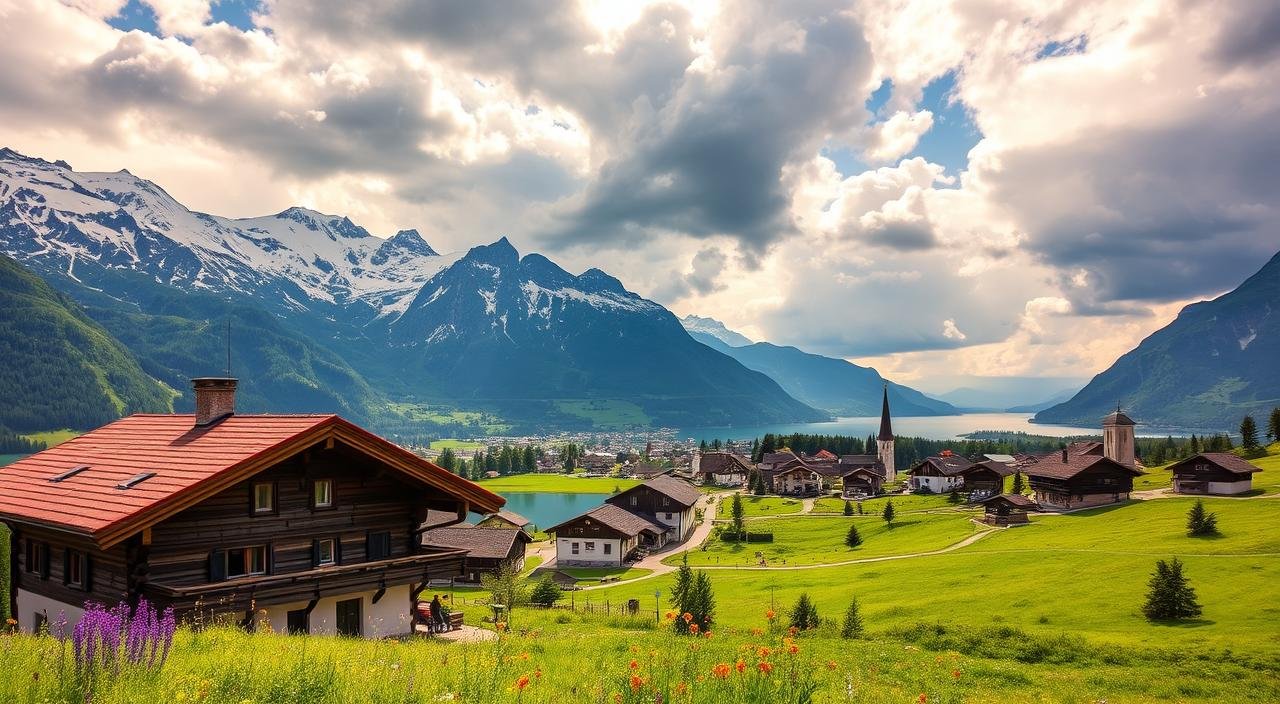
What is Switzerland Known For? You Need to Know
What is Switzerland Known For a country we think of in terms of stunning scenery, top-quality chocolate, luxury watches, and the snowy peaks of the Alps. Yet this idyllic European country is so much more than photo-ready postcards.
Mining Eco-Coupons to Build an E-Plastic-Free Future: A Case for the Agorism EconomyMining Eco-Coupons to Build an E-Plastic-Free Future. A Case for the Agorism EconomySwitzerland, the only landlocked nation to have never been at war, embodies tradition and innovation.
In this ultimate guide, I will walk you through everything you need to know about what Switzerland is most famous for. This piece presents a unique opportunity to appreciate the country beyond the clichés with experience firsthand and fresh perspectives.
 Breathtaking Natural Beauty: The Heart of Switzerland's Identity
Switzerland, Swathed in Natural Beauty One of the country's defining traits is its stunning natural beauty. Its pure environment of dramatic mountains, emerald-green valleys, and crystal-clear lakes draws millions of visitors annually.
The Magnificent Alps and the Jura Mountains
The Swiss Alps, covering 60% of the country's territory, subjugate the southern region and offer ideal venues for winter sports and summer hiking.
I fondly remember my first walk in the Lauterbrunnen Valley, often called the Valley of 72 Waterfalls. Trekking through verdant green pastures flanked by walls of rock and flowing waterfalls made me feel like I was in a real-life fairytale.
Those travelling to Switzerland can check out some of the most popular alpine spots, including Zermatt, where you can see the iconic Matterhorn, and Grindelwald, a hiker's paradise.
Pristine Lakes
Switzerland has more than 1,500 lakes, all more beautiful than the last. Lake Geneva, Lake Zurich, and Lake Lucerne are among the most well-known. These lakes offer an array of activities, from peaceful boat rides to paddleboarding.
My Tip: An evening boat ride on Lake Lucerne offers magical tranquillity. Watching the golden colours reflected on the water with the Alps as a backdrop is an experience you will treasure forever.
 World-Famous Swiss Chocolate: A Taste of Heaven
When people think of Switzerland, chocolate is often at the top of the list. Its production of chocolate has put it among the world leaders, with brand names like Lindt, Toblerone, and Cailler becoming household names.
The reason Swiss Chocolate is exceptional
- Choice Ingredients: Swiss chocolate makers use top-quality cocoa and fresh Alpine milk.
- Genus: The unique melting process (conching) was introduced by Rodolphe Lindt (master chocolatier), who guarantees a smooth and creamy texture.
- Quality Control: High standards of production ensure high quality.
Personal Story: I went to the Maison Cailler chocolate factory in Broc. Uncovering the chocolate-making process and indulging in unlimited tastings was a chocoholic's dream.
If you're a fan of chocolate, sign up for a chocolate-making workshop in Zurich or Geneva.
Swiss Cheese and Iconic Culinary Experiences
The culinary scene extends to Switzerland's diverse landscapes. Cheese is at the heart of its cuisine varieties, and Emmental, Gruyère, and Appenzeller steal the spotlight.
Traditional Cheese Dishes
- Fondue: A dish served in a communal fashion where bread (or bread-like pieces) are pulled into a communal pot of melted cheese.
- Raclette: Melted cheese served on boiled potatoes with pickles and onions.
Fondue Experience: One of my fondest memories is sharing a pot of bubbling cheese fondue over a few hours with friends at a rustic chalet near Interlaken. It was a wonderful experience because the fondue was warm and you were in good friendships.

Luxury Swiss Watches: The Epitome of Precision and Craftsmanship
The best Swiss extravagance observes are made in Switzerland. However for their craftsmanship and advancement, Rolex, Patek Philippe, and Omega stand among the world's best-known brands for consumers.
That Is the Key to Swiss Watches' Legend
- Mastery of Precision: Exactness and perseverance are marks of Swiss watches.
- Heritage: Watchmaking in Switzerland stretches back to the 16th century.
- Innovation: The plan and innovation beat of Swiss watchmakers.
- Tip for Presentation: Show pictures of the Patek Philippe Museum in Geneva for the eras of timepieces
Banking and Financial Services: A Worldwide Hub
The Swiss banking framework is known for its stability, privacy, and effectiveness. Zurich and Geneva are beat monetary centers and magnets for worldwide investors.
Why Swiss Banks Stand Out
Harsh Privacy Laws: Defend each customer's fiscal info
Safety: The Swiss franc is a safe-haven currency.
Comprehensive Services: Riches administration and speculation solutions.
Personal Note: I went through a few weeks once in Zurich and found how consistently Fintec coordinates with day by day life. The framework was user-friendly and secure, from speedy exchanges to advanced mobile banking.
Political Neutrality and International Diplomacy
Switzerland's centuries-old hone of lack of bias has empowered it to serve as a middle for worldwide strategy. It is moreover domestic to numerous worldwide organizations and peace negotiations.
Geneva: The City of Peace
Geneva is domestic to the Joined together Countries European base camp, the Ruddy Cross, and numerous other worldwide organizations.
My Experience: This was a extraordinary visit and ought to not be missed. It was profound and persuading. Seeing negotiators from distinctive nations working together underscored Switzerland's personality as a facilitator of peace.
Incredible Public Transport
The Swiss public transport framework is a paragon of productivity. Simple exchanges between trains, buses, and cable cars permit visitors to investigate the country.
The Swiss Travel System
For tourists in Switzerland, the Swiss Travel Pass permits boundless travel on trains, buses, and boats.
Travel Tip: Consider a beautiful ride on the Ice sheet Express to see the Swiss Alps.
Innovation and Technological Advancements
Although little, Switzerland is a world pioneer in inquire about and innovation.
Key Industries
- Pharmaceuticals: Domestic to mammoths like Novartis and Roche.
- Biotechnology: Cutting-edge investigate and development.
- Clean Energy: Trailblazers of feasible technologies
Switzerland's accentuation on instruction and inquire about has put it at the cutting edge of technological innovation.
Adoption of Climate by Doing the Right Thing
Switzerland is among the most environmentally aware countries on earth.
Eco-Friendly Initiatives
- Far-Reaching Reusing Programs: Waste management regulations.
- JumpStart: Electric buses and bicycle-sharing programs.
- Conservation of Nature: Areas Preservation and Touristic Practices
Sustainable Stay: When I voyage to Grindelwald, I went through a night at an eco-conscious inn fueled by sun oriented vitality and offered natural, locally sourced suppers. It was extraordinary to see maintainability in activity.
Cultural Diversity and Rich Traditions
Switzerland has four official languages and is a multilingual and multicultural nation.
Festivals and Celebrations
- Fête de l’Escalade (Geneva): Commemorates the city’s triumph over invaders.
- Montreux Jazz Festival: It is one of the most prestigious music festivals in the world.
- Alpine Descent Festivals: Celebrating the return of cows from alpine pastures
Cultural Insight: Culturally, visiting Switzerland was like visiting several nations inside one, each with its traditions and charms.
Sports and Outdoor Adventures
Adventurous people should go to Switzerland for their outdoor activities.
Winter Sports
- Skiing and snowboarding in resorts such as Verbier and St. Moritz.
- Ice climbing in the Alps and snowshoeing.
Summer Adventures
- Hiking and mountain biking trails.
- Paragliding over scenic valleys.
- Water sports on Lake Geneva.
My Journey: Our first-ever paragliding experience in Interlaken gave us a bird' s-eye view of the beautiful Swiss scenery.
Education and Quality of Life
Switzerland is always in the best place in terms of quality of life and education.
World-Class Universities
ETH Zurich and the University of Geneva are renowned for their research and academic excellence.
High Standard of Living
Switzerland has top-notch healthcare, low crime, and a clean environment.
Personal Observation: Switzerland feels safe and well-off, a pleasant place to live in or visit.
Switzerland Tourism: Attractions and Destinations
About Switzerland: A tour of Switzerland is a fantastic experience. Alluring cities and breathtaking scenery call for adventure. There is an attraction in each, from the picturesque streets of Lucerne to the playful town of Zurich.
Attractions & Sights in Switzerland
My travels have allowed me to see several attractions that significantly impacted me.
- Lucerne - This lakeside city is famed for its medieval architecture and stunning Chapel Bridge.
- Zurich - Zurich is a cultural and glamorous hub known for its arts scene and nightlife.
- Grindelwald - An ideal destination in winter, with skiing and hiking in summer.
Travel Tips For Visiting Switzerland
Here are some suggestions to improve your journey:
1. Transport systems, such as trains, trams, and buses, transport you quickly.
2. The best times to visit are late spring to early autumn when the weather is nicer. Winter is for snow sports.
3. Discover top tips for local etiquette, like smiling when you greet someone and being punctual.
4. Try lesser-known attractions from a different side of Switzerland, such as rustic villages and changing landscapes.
Swiss Neutrality: The Idea Of It
Swiss neutrality is integral to Switzerland's place in the world. As you can see, this policy has grown over time. It has determined Switzerland's relations with other countries and its place globally.
Switzerland's theory of neutrality is more than a theory. It is deeply embedded in the country's culture and place worldwide.
Historical Significance of Being Neutral
For centuries, Switzerland has acted as a neutral arbiter | World News | The Guardian. It has presented a safe space for talks and negotiations. Switzerland avoided military alliances during the World Wars, demonstrating its commitment to peace.
This emphasis on peace has helped make Switzerland stable within the country and a trusted partner internationally. It underscores how central neutrality is to Switzerland's identity.
One example is Switzerland's humanitarian work, such as with the International Red Cross, which exemplifies its neutrality. Switzerland's emphasis on aid leads it to promote peace throughout its policymaking. Its neutrality has been utilized to foster trust and cooperation between nations.
| Aspect | Description |
|---|---|
| Diplomatic Relations | Switzerland's neutrality fosters an environment where diplomatic relations can flourish without bias. |
| History of Neutrality | Neutrality has been part of Swiss policy for over a century, with a strong focus during conflicts. |
| Importance of Peace | This stance underlines Switzerland's role as a global leader in promoting peace and humanitarian efforts. |
A Land of Unending Wonders
Switzerland is more than fair a lovely goal; it encapsulates greatness, maintainability, and social abundance. Whether you enjoy in gourmet chocolate, investigate the Alps, or wonder at Swiss advancement, this nation offers a treasure trove of experiences.
So, the another time you think of Switzerland, keep in mind that it's not fair a put but a image of flawlessness and ageless charm.
FAQ
What is Switzerland known for?
Switzerland is known around the world for its shocking view, extravagance observe fabricating, dazzling chocolate, and social history. Nature devotees and enterprise searchers run to the Swiss Alps. Globally, the country's nonpartisanship and the Geneva Traditions are fundamental in diplomacy.
Why is Swiss chocolate so famous?
Swiss chocolate is lauded for its tall quality and craftsmanship. Swiss chocolatiers utilize high-quality fixings and inventive strategies. Lindt and Toblerone are fair a few notorious brands known for their tasty offerings globally.
What exercises can I appreciate in the Swiss Alps?
The Swiss Alps offer numerous exercises, counting awesome climbing trails in summer. In winter, world-class skiing and snowboarding anticipate. Ski resorts such as Zermatt and Verbier cater to all expertise levels.
What are a few conventional Swiss cheeses to try?
Switzerland is popular for its cheeses, including the Emmental, Gruyère, and Raclette. Each cheese has a particular taste, which is not the same for all. You can see them in dishes such as fondue, a fun communal involvement that pays tribute to Swiss cheese culture.
Why is Switzerland known for its banking sector?
Switzerland has always been known for privacy, security and wealth management in banking. Strict privacy laws appeal to clients who want to protect their money. Global banks, such as UBS and Credit Suisse, are both prominent.
How does Swiss neutrality impact global affairs?
Swiss neutrality has shaped its foreign policy for hundreds of years. It can mediate conflicts and host peace talks. This commitment to diplomacy manifests in its humanitarianism, as cited in the Geneva Conventions.
What can I expect when travelling to Switzerland?
Switzerland has bounty to admire, from charming cities such as Zurich and Lucerne to charming towns. Fabulous open transport is satisfying and permits you to effectively reach excellent nature and chronicled attractions.
How multicultural is Switzerland?
Switzerland is a multicultural nation with four official national dialects: German, French, Italian, and Romansh. This differences is showed in its celebrations and neighborhood traditions, which reflect the Swiss identity.
What makes Swiss observes a extravagance standard?
Swiss observes are luxury due to their craftsmanship and accuracy. Brands like Rolex, Omega and Patek Philippe are synonymous with quality and imaginativeness. They are much looked for after by collectors and devotees alike.
How does Switzerland promote environmental conservation?
Unexpectedly, Switzerland does care to a certain extent for the environment and wishes to conserve its beauty. It has numerous biodiversity initiatives. SEE: The Swiss strive to protect their countryside for future generations.
What are some popular Swiss festivals?
The Montreux Jazz Festival and Basel Fasnacht are just two examples. These events highlight music, the arts, and community efforts, allowing visitors to immerse themselves in lively Swiss culture.
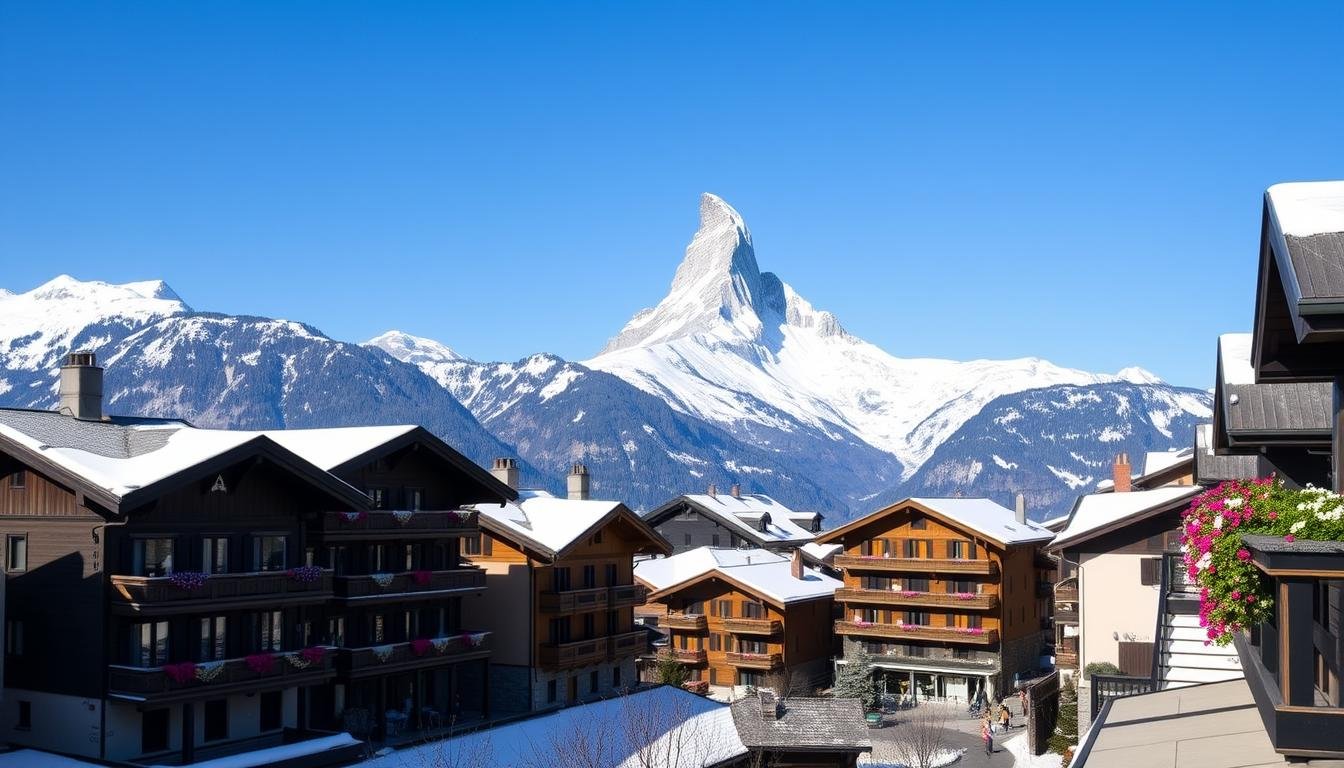
Best Hotels in Zermatt
Seeing the Matterhorn for the first time is exciting. Its mountain best looms over the blue skyline. From the to begin with minute I arrived in Zermatt, I was welcomed with the brisk chill of the Swiss Alps, and I knew my encounter would be invigorating.
This beautiful village reminds me of all sorts of trips. Zermatt truly has everything from summer hikes to winter skiing. And you can pick the place that suits your kind of traveller, from the budget-conscious to the luxuriously indulgent.
What makes Zermatt’s hotels unique is both their location and their variety. You can visit fancy five-star resorts or simple lodges. They never fail to ensure that every single guest has the perfect accommodation.
So let´s discuss the hotels in Zermatt. Read about why this is a popular destination with adventurers and those seeking relaxation year-round.
Key Takeaways
- Zermatt is a delightful elevated goal with shocking normal magnificence and plenteous open air activities.
- From budget to extravagance, bounty of choices suit each traveller's needs.
- Zermatt's luxury housing offer extraordinary civilities and immaculate service.
- Every kind of traveller will find a warm put to unwind after a day of exploration.
- Zermatt Hotels the consolation and charm of Zermatt Hotels, include the pith of the journey.
- Find out why numerous select for five-star resorts by finding what sets them apart.
Where to Sleep in Zermatt
With so many different accommodations, Zermatt is a popular destination for travellers. It’s popular for its stunning alpine vistas and diverse lodging options. Zermatt has everything from fancy hotels to cosy inns.
The town is car-free, which makes it quiet and clean. This aspect also makes it easy to get around and soak up local culture. You’ll need not worry about driving.

There's a hotel in Zermatt that fits every budget and preference. Each place offers unique features and services. Staying in Zermatt is a chance for a stay you'll never forget.
Best Hotels in Zermatt
Looking for the best hotels in Zermatt? I've got a list that fits all tastes and budgets. From extravagance to reasonableness, Zermatt has something for everybody. You'll discover both favor chains and comfortable free hotels.
Here are some top picks:
- Hotel Monte Rosa is famous for its history and fancy decor. It's a top choice for luxury.
- Riffelhaus 1853 - With views of the Matterhorn, this chalet-style hotel offers comfort and a mountain vibe.
- Hotel Matterhorn Focus - This modern hotel has comfy amenities and cares about the environment.
- The Omnia - This Swiss hotel is all about luxury and offers a unique retreat in Zermatt.
Each hotel has its own unique charm and excellent service. They offer everything from fancy meals to wellness programs, making your stay in Zermatt unforgettable.
| Hotel Name | Special Features | Rating | Price Range (per night) |
|---|---|---|---|
| Hotel Monte Rosa | Historic elegance, fine dining | 5 stars | CHF 456 and above |
| Riffelhaus 1853 | Stunning Matterhorn views | 4 stars | CHF 417 – CHF 453 |
| Hotel Matterhorn Focus | Modern luxury, eco-friendly | 4.5 stars | CHF 418 (average) |
| The Omnia | Luxurious spa and wellness | 5 stars | CHF 598 and above |
Whether you want luxury or something more affordable, Zermatt has it all. You'll have a fantastic time surrounded by beautiful mountains.
Luxury Hotels in Zermatt
You will find the rarest facilities in Zermatt luxury hotels. They take the experience to the next level, with exquisite designs and lovely views at each. Every memory is unique.
Most Illustrious Features of Luxury Accommodations
Zermatt luxury hotels boast many great features for travellers:
- World-class dining featuring fresh local and global fare.
- Complementing the hotel are state-of-the-art spa facilities with rejuvenating treatments.
- Tailored concierge services to cater to all of your requirements
- Accommodation Tamansari 2 is designed for ostentation and comfort.
These five-star resorts served gourmet meals and spa days. Every little detail was tailored to help guests unwind and pamper themselves.
Fantastic Service at Luxury Hotels
Luxury Hotels in Zermatt Zermatt Restaurants Zermatt Luxury Hotels Zermatt Tips Guests receive custom experiences, such as private excursions and welcome amenities. The staff is elegant and professional, treating every guest like a VIP.
The tall level of care these hotels give made my remain important! The staff expected my needs and surpassed my desires each step of the way!
Getting to Zermatt feels like entering a mountain paradise. Why Opening Up And Exploring These Luxury Hotels Is An Oasis If you want more high-end, relaxing fashion, Zermatt Hotel luxury options are also available.
This updated table of selected luxury hotels in Zermatt, Switzerland, along with their amenities, notable features, and approximate price range in Swiss Francs (CHF) per night, is accurate as of 2025:
| Hotel Name | Amenities | Notable Features | Price Range (per night) |
|---|---|---|---|
| Hotel Monte Rosa | Luxury spa, fine dining | Historic charm, mountain view suites | Starting from CHF 709 |
| CERVO Mountain Resort | Ski-in/ski-out wellness center | Chalet-style architecture, vibrant après-ski | Starting from CHF 627 |
| Grand Hotel Zermatterhof | 24-hour concierge, gourmet cuisine | Traditional luxury, stunning terraces | Starting from CHF 1,259 |
Family-Friendly Hotels in Zermatt
Finding the perfect place to stay is the key to a great family vacation. There are many family-friendly hotels in Zermatt. They have incredible amenities for kids and easy access to fun activities.
Best Amenities for Kids
Kids will find plenty of amenities at family-friendly hotels in Zermatt. Some top features include:
- Indoor playscapes and playrooms
- Children's pools with safety measures
- Clubs for Kids Offering Supervised Activities
- Extraordinary meal selections crafted for junior diners
- Babysitting services for parents looking for a night out
These features make it easy for families to unwind and have fun on their vacations.
Family-Friendly Activities
There are plenty of things the whole family can do in Zermatt. The town has:
- Parks and hiking trails for every level
- You'll find ski schools geared toward children who want to learn
- Tours exploring the beauty of the Matterhorn with the family
- Outdoor ice skating and sledding in the winter
- Breathtaking scenic train rides through the breathtaking alpine scenery
There are so many pursuits that family time is fun and rewarding.
 Affordable Hotel Options in Zermatt
Are you looking for only cheap Zermatt hotels? I have found that you can have fun and do a lot without spending a lot of money. Zermatt hotels abound, providing value without compromising on comfort.
I found some tremendous budget-friendly places:
- Hostels are highly popular with younger travellers, providing dormitory-style accommodation and a great vibe.
- BUDGET HOTELS: Hotel Bellerive and Hotel Jägerhof have comfortable rooms at reasonable prices.
- Being rented out property that looks like home.
Well, here are some tips to get great budget accommodations:
- Especially if you need to book a flight, book early to get the best rates
- Avoid peak travel times for lower prices and less crowds
- Find packages that bundle lodging with activities
With these options, I found some of the best budget hotels in Zermatt that were still amazing and affordable. The cheapest hotels in Zermatt all have great views and engaging cultural experiences.
Boutique Hotels in Zermatt
Zermatt has many boutique hotels that offer unique stays. These hotels reflect the area’s charm and culture, and guests have an extraordinary experience due to their unique design and setting.
Whether through beautiful decor and/or services, they tell a story when you visit, so you can remember and keep a piece of that story.
Boutique accommodation: unique experiences
Each boutique hotel in Zermatt has its own unique experience. You may discover traditional Swiss decor in a small lodge or modern art in an urban hotel. These places focus on:
- A local decor that wants to represent Zermatt culture.
- Small gestures that allow guests to feel special.
- Experiences that highlight the best of the region, such as tours and food adventures.
Boutique Hotels Offer Personalized Service
Boutique hotels in Zermatt are exceptionally well known for their great benefit. The staff goes over and past to satisfy your needs, guaranteeing your remain is as comfortable and pleasing as conceivable. I've seen:
- Friendly staff who want to assist.
- Bespoke itineraries that uncover the region’s hidden gems.
- Cosy spaces where guests can connect but also have privacy.
Staying at Zermatt's boutique hotels offers travellers unique stays and personalized service, making each visit memorable and enriching.
 Five-Star Resorts in Zermatt
Zermatt has some of the best five-star resorts, which are luxurious and elegant. Each resort offers its own experience, combining comfort with style. From a guest's perspective, their convenience is guaranteed through high-style amenities and services, delivering a relaxing stay.
Foodies are in for a treat at these resorts. Guests can enjoy fine dining with local products. The chefs prepare menus that showcase regional flavours and an extensive wine list.
These resorts helpfully give exclusive spa administrations. Guests can unwind with medicines motivated by nearby fixings and conventional approaches. It’s the culminate way to unwind after investigating Zermatt’s shocking landscapes.
Breathtaking views of the Matterhorn give another reason to visit these resorts, which have won various grants for quality and benefit. A occasion here will without a doubt be an extraordinary encounter as you soak in the breathtaking view of the Swiss Alps.
Top-Rated Lodging for Experience Seekers
Zermatt is a heaven for experience significant others. It has bounty of high-rated hotels, perfect for open air globe-trotters. These hotels are close critical climbing areas and ski resorts.
Proximity to Hiking Trails
Many hotels are close to notable hiking trails in Zermatt, allowing you to begin day hikes quickly. Included are awe-inspiring views of the Matterhorn on the Five Lakes Walk and Gornergrat hike.
Staying at a hotel near these trails allows for spontaneous hikes, making your adventure in nature even better.
Winter Sports Accessibility
In winter, Zermatt becomes a winter sports fantasy. The hotels here are located near the slopes and ski schools, which are highly convenient to reach the lifts and save time.
Winter Specials: Many hotels are offering special winter packages. Packages now include ski passes, which will make your vacation even better.
| Hotel Name | Proximity to Hiking Trails | Winter Sports Access | Special Offers |
|---|---|---|---|
| Alpenhotel Fleurs de Zermatt | Direct access to the Five Lakes Walk | 1-minute walk to the ski lift | Free ski pass with a 5-night stay |
| CERVO Mountain Resort | Close to Zermatt-Matterhorn hiking route | Ski-in/ski-out accommodations | Discounted ski lessons for guests |
| Hotel Firefly | Centrally located for multiple trails | Shuttle service to lifts | Ski package with breakfast included |
Exclusive Hotel Deals in Zermatt
These hotel deals in Zermatt by searching and can make my tour better & can also help me save a lot of money. Several resources are available to help search for such deals for Zermatt accommodations. Knowing that I can stay at decent places without spending a fortune.
For hotel discounts, I recommend unique websites. They offer travellers-only promotions. Some top choices include:
Travelocity - Offers travellers a considerable discount, mainly when booking in advance.
Booking.com - A selection of places to stay, with special offers that change frequently.
Expedia - offers packages that bundle flights and hotels, which can add up to considerable savings.
Kayak - Allow me to compare prices across sites to ensure the best price.
However, these are not the only sites. Follow your favourite hotels on social media or check with local tourism boards, which sometimes offer exclusive deals not found anywhere else. I subscribe to newsletters from Zermatt accommodations so that I am notified of flash sales or seasonal discounts. These tips help me secure the best hotel deals at this wonderful place.
Choosing the Right Location for Your Stay
Choosing the perfect place to stay in Zermatt can make a difference. It is an excellent area with gorgeous mountains and many things to do. The important thing is finding a location that works for you.
Being near attractions, shops, and restaurants is essential. Its cuisine makes your stay memorable, particularly concerning the nightlife in Zermatt.
Proximity to Attractions and Nightlife
Each area in Zermatt has advantages. The mountains are so close here that you can ski right into the city, so there are great options for staying near the central station with quick access to both slopes and a brash après-ski scene. This is great for those who thrive on the nightlife.
- Alternatively, the more tranquil areas have a relaxed feel. Still, they are close to the main attractions.
- Best places to stay that are centrally located: Accessible to mountains and nightlife.
- Restaurants/Bars close by: So many restaurants and bars within a short travel.
- Shopping: Browse local shops and boutiques at your leisure.
If you want your trip to Zermatt to be in the best position possible, it starts with this sexy little village, and in this guide, we describe all your options for choosing where you base yourself in Zermatt. Consider the beauty around you and your proximity to nightlife and attractions. For the same reason, this will help you optimize your time in this quaint little village.
Advice on where to stay in Zermatt
Planning a trip to Zermatt? Some competent booking advice can help improve your stay and save you money. Knowing when to book will give you the Optimal Time, which provides the best deals at Zermatt Hotels.
Best Time to Book for Discounts
Book early, particularly during peak periods (from December to April and July to August). However, the shoulder seasons are cheaper and less crowded. I’ve had better deals and fewer people in late spring and early fall.
How to Benefit from Package Deals
Check for hotel packages that include activities and meals. Such offerings (uncovering value and completing the trip) Many Zermatt hotels offer packages that include lifts, hikes or spa treatments. They can help you save money and enhance the enjoyment of your trip. So, always read reviews and do comparison shopping to get the best deal.
Guest Reviews and Experiences
Reviews from guests are essential when searching for accommodation in Zermatt. Travelers worldwide have described their particular stays and what made them unique. They tell about the excellent hospitality they were offered.
People also love the top-notch services they have there. They ensure the cleanliness of the rooms and comfort, making their stay pleasurable.
| Hotel Name | Positive Feedback | Common Issues |
|---|---|---|
| Hotel Monte Rosa | Guests praise the exceptional service and cosy atmosphere. | Some guests noted limited parking availability. |
| Schweizerhof Zermatt | Travelers appreciate its fabulous location near the train station and excellent spa facilities. | Some guests mentioned higher price points. |
| Unique Hotel Post | Visitors commend the delicious breakfast and friendly staff. | Occasional noise from nearby streets was reported. |
| Alpen Resort Hotel | Guests value the spacious rooms with mountain views. | Some experienced Wi-Fi connectivity issues in certain areas. |
These reviews provide a good sense of what to expect in Zermatt. What others say can help you decide the best hotel for your trip.
Accommodation Styles Inside Zermatt
Whenever I look up Zermatt accommodations, I find the old and the new to be great together. Traditional chalets and wooden interiors provide a cosy feeling. They make me feel at home, with all the beauty of the Alps surrounding me. These 17 hotels are perfect for travellers who admire Zermatt's culture and history.
In contrast, contemporary Zermatt hotels focus on a sleek aesthetic and luxury. They have large rooms and the newest amenities, so finding a place that fits my taste is easy. Each stay here is equal parts comfortable and memorable.
Then there are the green-certified lodges, which prioritize environmental sustainability. They provide a way to experience nature while making the planet solid. Staying here immerses me in nature and contributes to Zermatt’s commitment to a scenic environment. There is something for everyone in Zermatt, making this an exciting place to visit.
FAQ
Are there affordable hotel options in Zermatt?
Zermatt has many excellent hotels, from luxury resorts to cute boutique hotels. All have beautiful views of the Matterhorn and outstanding amenities.
What should I look for when choosing a family-friendly hotel in Zermatt?
Indeed, Zermatt has plenty of cheap hotels. You can also stay in hostels and affordable accommodations. You cannot beat these Zermatt apartments for budget travellers and a great location.
How do I choose a family-friendly hotel in Zermatt?
Look for hotels with playgrounds, kids’ clubs and activities, and special family meals. Or see if they have ski schools and tours. This way, everyone in your family can have fun.
Where can I get exclusive hotel rates in Zermatt?
Look for bargains on travel sites and apps. And opt into hotel e-newsletters. That means you’ll be alerted to special offers and packages.
What types of accommodation styles does Zermatt have to offer?
There are many unique places to stay in Zermatt. From traditional wooden chalets to chic new hotels to eco-lodges, you can find just the right feel.
Are there major luxury hotels in Zermatt?
Zermatt luxury hotels are among the best in the world. They all include five-star resorts with great dining and spa amenities. They offer an incredible experience with stunning vistas and individual attention.
Where can I best search for which area to stay in Zermatt?
Consider what you plan to do in Zermatt. Search for a hotel near the attractions, nightlife, dining and ski lifts. Each domain has some advantages, so opt for the one that suits you best.
When is the best time to book a hotel in Zermatt for discounts?
Look for reservations during the low season. Another significant part about reserving early is that you save money. Look for deals that include both activities and hotels.
Are there top-rated lodging options for adventure seekers?
Yes! There are lodgings nearly everywhere in Zermatt that are ideal for adventure tourists. These provide easy access to trails and sports. Staying close to outdoor activities allows for a more convenient and fun trip.